BondCliQ CEO Chris White co-authored this provocative market structure blog with Manisha Kimmel, the chief policy officer at MayStreet.
Are there inalienable rights that all markets participants should have when it comes to market data?
Their price quotes are now in the mix with bigger bond dealers
A new link to leading trading software makes them actionable
Bond traders at firms owned by minorities, women and veterans have for years yearned to operate on a level playing field with Wall Street giants. A market-data startup just rolled out something that could help.
BondCliQ, a New York-based firm that offers a centralized feed of real-time bond quotes, in the past two months got added to trading software developed by firms including State Street Corp.’s Charles River. This significantly increases the pool of money managers that can trade against quotes posted by dealers on BondCliQ by connecting them to products used by investors with trillions in assets.
While that will benefit all the dealers on BondCliQ, those with diverse ownership stand to gain the most, founder Chris White said. That’s because they lack the technology and widespread connections across the industry, and BondCliQ is working to promote their bids and offers in particular, White said.
“We’re delivering a piece of architecture that’s missing from the market,” White, a former Goldman Sachs Group Inc. technology executive, said in an interview. “It’s much easier for customers to find the dealer that deserves their order because it’s delivered right into their workflow.”
The deal with Charles River, which caters to investors with more than $30 trillion in assets, could massively increase BondCliQ’s reach since it makes one of the most popular order-management systems for bonds. The connection will help BondCliQ’s nine emerging dealers — or those with diverse ownership — access those investors directly, giving them an opportunity to win more business in a market dominated by the biggest Wall Street banks. Currently, BondCliQ has 14 buyside clients with a combined $750 billion of assets using its data.
The bond market is one of the most notoriously opaque corners of finance, where relationships between the buyside and sellside still dictate much of the activity for new debt sales and trading. Technological advancements in the primary and secondary markets are slowly democratizing the business, but the likes of JPMorgan Chase & Co., Bank of America Corp. and Citigroup Inc. still dominate with their vast operations and distribution networks, making it difficult for smaller banks to break through.
“Extracting information in the marketplace is the hardest thing for us to do,” said Carmine Urciuoli, head of fixed-income sales and trading at AmeriVet Securities, which was founded by a Black, disabled veteran. “Having high-quality secondary information is critical to defining a narrative to a client,” whether that’s an investor or an issuer, he said.
(Bloomberg LP, the parent of Bloomberg News, also offers fixed-income trading, data and information to the financial-services industry.)
Improving Distribution
Similar to the early days of Nasdaq, which started out in the 1970s as just a bulletin board for stock quotes posted by dealers before evolving into an exchange giant, BondCliQ aggregates bids and offers for corporate bonds from 41 dealers all in one place. Once the counterparties are connected, they can turn to electronic venues like MarketAxess Holdings Inc. or Tradeweb Markets Inc. or message each other directly to execute the transaction.
BondCliQ’s new tech partners will help simplify how dealers communicate pre-trade data to investors. Buyside participants globally can access BondCliQ quotes via Charles River, which largely caters to U.S. clients, as well as order management systems like Tora, which mostly serves Asia, and IHS Markit Ltd.’s thinkFolio with a European focus, White said.
While they’re starting to gain more traction in the primary market amid record bond sales and renewed attention on social-justice issues after George Floyd’s killing, diverse banks lag behind major Wall Street firms in the secondary market — or trading bonds after their initial issuance. The upstarts have smaller balance sheets, less sophisticated technology and a shorter roster of traders.
Unlike the primary market, where companies sometimes factor in diversity when hiring banks to sell their debt, dealers are on their own in the secondary market, where investors are largely driven by the desire to achieve best execution, no matter who’s on the other side of the trade.
“Maybe before I was the best level, but people didn’t see me,” said Jared Kurtzer, managing partner at American Veterans Group. “Now that I’m on BondCliQ, we can compete with each other and let the best level win.”
A Tale of Two Platforms …
Charles River Development Workflow with BondCliQ Widgets Promo Video: http://bondcliq.com/wp-content/uploads/2021/01/CRD%20Demo%20Video%20%28final%29.mp4
Bank debt leads corporate bond rally sparked by COVID-19 vaccine rollout
Bank debt has been a hot commodity in the near two weeks since the Food and Drug Administration authorized the first COVID-19 vaccine for emergency use in the U.S.
Bonds issued by Bank of America Corp. BAC, -0.35%, JPMorgan Chase & Co. JPM, -0.02% and Citigroup Inc. C, -1.62% on Tuesday topped the list of 40 most-active U.S. corporate bonds traded since Dec. 11, when the FDA greenlighted the first COVID-19 vaccine for distribution in the U.S., according to BondCliq data.
That is when BioNTech BNTX, -5.34% and Pfizer Inc.’s PFE, -0.45% COVID-19 vaccine was waved through to start distribution in the U.S., while a shot developed by Moderna Inc. MRNA, -7.94% is quickly becoming a second option as the nation races to gain control of the pandemic.
Here’s a chart showing the top 40 most actively traded U.S. corporate bonds since the vaccine rollout.
Banks top post-vaccine corporate bond trades BONDCLIQ
The broad rally, led by bank debt, comes after shares of financial companies were pummeled in 2020, with investors initially shunning segments of the economy viewed as vulnerable to the pandemic’s shocks and its aftermath.
Banks not only hold consumer deposits, but they also make real-estate loans and arrange financing, mergers, acquisitions and equity deals for major U.S. corporations, or a direct link to the health of the economy.
In a hopeful sign this fall, debt investors started to change their tune, at least when making shorter-term bets on major banks.
BondCliQ data for December shows the rally in bank debt now has expanded to bonds due in 10 years and beyond, indicating that investors have become more hopeful that a successful vaccination program will help drive economic recovery and reduce credit losses.
“Banks were as much in the crosshairs during the initial stage of the COVID outbreak as anything,” Brian Levitt, Invesco’s global market strategist, told MarketWatch, adding that the big fear in any recession is that stress will find its way into the banking system.
But those concerns subsided after the Federal Reserve stepped in with a raft of emergency lending facilities, including buying up corporate debt for the first time ever this spring.
Now there’s optimism around the vaccine rollout helping to spur further economic recovery in 2021, Levitt said, adding that the expectation is that the 10 year U.S. Treasury yield TMUBMUSD10Y, 0.941% also will likely move higher, helping banks which lend based on the benchmark.
“That type of environment favors cyclical assets, and that’s largely the banks,” he said.
Bank shares closed lower Tuesday, but rallied to kick off Christmas week, after the Fed on Friday gave lenders the green light to start buying back stock again in 2021, a reversal of restrictions put in place in June amid concerns about the COVID-19 pandemic.
The Dow Jones Industrial Average DJIA, 0.67% fell 200 points Tuesday, pressured lower by concerns about a new strain of the coronavirus in the U.K. that curbed travel from the nation to swaths of the globe.
Bank bonds issued by Morgan Stanley MS, -0.49%, Wells Fargo & Co. WFC, +0.02% and Goldman Sachs Group Inc. GS, -1.22% also were among the top 10 most actively traded debt since Dec. 11.
Bucking the broader rally was debt issued by a handful of companies, including Verizon Communications Inc. VZ, -0.55%, Ford Motor Co. F, -0.67% and Apple Inc. AAPL, -0.48%.
BondCliQ CEO Chris White weighs in on the retail industry’s debt
Diving into retail debt with Chris White, BondCliQ CEO. With CNBC’s Melissa Lee and the Fast Money traders, Guy Adami, Tim Seymour, Karen Finerman and Steve Grasso.
News on newly issued securities in the Americas 16 November 2020
Call it the Antiques Roadshow of the corporate bond market.
Even as COVID-19 cases surge to alarming rates and rattle markets, debt investors in November have been rummaging through the U.S. corporate bond market for bargains created by the pandemic.
The debt of “fallen angels” Ford Motor F, -1.44% and Occidental Petroleum Corp. OXY, -4.95% was among the most actively traded by midmonth, amid an overall sea of green for U.S. speculative-grade, or “junk-rated” corporate bonds so far in November, according to data from BondCliq.
Both the debt-laden Ford and oil and gas producer Occidental saw their coveted investment-grade credit ratings cut to junk territory, or BB+ or lower in March as the coronavirus bore down on the U.S.
This chart shows the top 24 U.S. junk-bond issuers by trading volume so far in November, with Ford’s debt the most actively traded.
Top 24 junk-bond trades in Nov. BONDCLIQ
Green colors indicate a broad rally in bonds from Nov. 2 to Nov. 12, even though the Dow Jones Industrial Average DJIA, -1.08% was down 1.3% on Thursday and the junk-bond market was selling off.
The iShares iBoxx High Yield Corporate Bond ETF HYG, -0.67% was down about 0.5% Thursday, but still up 1.7% for the month, according to FactSet. The VanEck Vectors Fallen Angel High Yield Bond ETF ANGL, -0.45% slumped 0.5% Thursday, but was on pace for a 2.5% monthly gain.
BondCliq data also shows that nearly $50 billion worth of junk-bonds traded already his month, a 16% uptick from the same period of October.
The continued hunt for bargains followed a dramatic selloff in October for equities and debt markets, as parts of Europe rolled out fresh curfews and restrictions on social gatherings as COVID-19 infections hit records.
And alarming new milestones in the pandemic this week, including fresh curfews on bars and restaurants in New York City and elsewhere, cut into a rally in riskier assets sparked earlier in the week by promising developments on the COVID-19 vaccine front.
But what might be another period where bad news may be good news, debt investors looking for fallen angel bargains could be in luck, particularly as already struggling corporations grapple with the added shocks of the pandemic.
“We couldn’t be more excited as fallen angel and high yield investors,” said Manuel Hayes, senior portfolio manager of Mellon’s Efficient Beta Fallen Angels strategy. “In our view, the more downgrades there are the more discounts are available for those who can cost effectively and efficiently harvest this opportunity set.”
This year already has seen some $170 billion of formerly U.S. investment-grade corporate debt downgraded to junk-bond territory, according to BofA Global analysts, who expect another $50 billion to cross over in the next 12 months.
The potential for a deluge of corporate debt downgrades that could swamp the junk-bond market has been a key concern for investors, central bankers and regulators for years.
Those worries turned feverish this spring, after states and cities across the nation ordered businesses to temporarily close in a bid to contain the first wave of U.S. COVID-19 outbreaks.
But sentiment around corporate debt also quickly shifted to bullish from bearish after the Federal Reserve in April expanded its foray ever into buying corporate debt to include “fallen angels,” as it looked to stabilize markets that began to spiral out of control in March.
Hayes pointed out that as bonds pass from investment-grade to junk territory, they can create a wave of forced selling, because many investors often lack a mandate to own both types of debt, but when oversold this creates an opportunity for other investors to buy cheaply.
Kohlberg Kravis Roberts & Co.’s KKR Credit also pointed out that fallen angles produced an eye-popping 31.3% total return in the highly volatile stretch from the March 23 pandemic low to Sept. 30, which compared with a 18.42% return for investment-grade corporate bonds, in a note recapping third-quarter performance.
What the upcoming Supreme Court ACA hearing could mean for debt of healthcare companies
With the presidential election looming as well as a Supreme Court hearing on the Affordable Care Act, BondCliq CEO Chris White joins Yahoo Finance to discuss how the debt of healthcare companies has performed.
Extra compensation offered if Boeing’s credit ratings fall into “junk” category
Boeing Co. returned to the borrowing trough on Thursday with a four-part bond deal, a day after reporting third-quarter results that weren’t as bad as Wall Street feared though they highlighted the embattled aircraft maker’s significant cash burn.
Bankers and investors still need to haggle over the ultimate size and price of Boeing’s BA, -3.10% new debt financing, but order books for the transaction already have reached about $12 billion on what could end up being at least a $4 billion pile of fresh corporate debt, according to an investor monitoring the transaction.
Boeing said in a public filing Thursday that it may use proceeds from the bond sale to repay near-term debts. The company had $3.6 billion of short term debt due, according to a report from CreditSights.
Pushing out maturing debts into the future has been a lifeline for cash-strapped U.S. corporations hard-hit by the pandemic, with air travel still almost 70% below levels seen before the pandemic.
In addition to announcing more staff cuts, Boeing on Wednesday also reported that it burned through $5.1 billion of free cash flow in the third quarter, or less than its $5.6 billion cash burn in the second quarter, as the company continues to grapple with the economic toll of the pandemic and its still grounded 737 Max fleet program.
Boeing assumes that passenger air traffic will return to 2019 levels in about three years, even as Europe and parts of the U.S. battle once again with record COVID-19 cases.
Initial price guidance on its new bonds ranged from a spread of 195 basis points above Treasurys TMUBMUSD10Y, 0.856% for its 3-year class to 300 basis points above the risk-free benchmark for its longest 10-year parcel, according to Ashwin Tiruvasu at CreditSights. Those levels often move with investor demand.
Spreads are the level of compensation investors earn on bonds above a risk-free benchmark, with increasing spreads often pointing to a riskier asset or market tone.
U.S. stocks were on the climb Thursday after Wednesday’s rout left the Dow Jones Industrial Average DJIA, -1.46% down 943 points.
In the bond market, Boeing’s debt was under pressure and among the most actively traded of the Dow’s 30 companies on Thursday, even when looking at debt maturing in five years, 30 years and beyond, according to BondCliq data.
Boeing bonds under pressure BONDCLIQ
Tiruvasu at CreditSights said that Boeing bond’s initial price levels likely weren’t enough to “fully compensate investors” for the risk of the company’s credit ratings being downgraded to “junk” or the speculative-grade category.
Fitch Ratings cut Boeing’s corporate debt ratings one notch to BBB- from BBB, with a negative outlook on Thursday, effectively putting the debt on the cusp of falling into the junk category. The credit rating firm pointed to a “prolonged recovery from the pandemic” compared with Fitch’s “original expectations,” as well as the challenges to Boeings financial metrics due to its grounded 737 Max operations, as forming its rationale.
Like Boeing’s prior bond deal in April, the new bonds will offer investors concessions if the debt loses its coveted investment grade ratings. Specifically, investors in the new bonds would earn another 25 basis points of additional spread per each ratings notch cut by Moody’s Investors Service below its current Baa2 level or S&P Global’s BBB- grades, the cusp of junk territory.
Third-quarter corporate earnings kicked off this week with debt investors taking a more bullish view on big banks over the next five years.
That’s at least the signal coming from the bond market, where investors have been busy snapping up shorter-term bank debt on the view that major lenders can benefit as the economy heals from the worst of the coronavirus crisis.
This chart shows clusters of trades concentrated in shorter-term bank debt since Monday, when Wall Street’s biggest lenders kicked off corporate earnings in earnest.
Betting on short-term debt – BONDCLIQ
Green bubbles signify trading in big-bank bonds where spreads have tightened, often due to higher demand or the perception that an asset poses less of a default risk. Red bubbles point to more risk-averse trading. Spreads are the level of compensation investors earn on a bond above a risk-free benchmark, often U.S. Treasurys TY00, -0.04%.
The more bullish tone for bank debt comes as the industry enters the homestretch of a punishing year, with banking shares still down about 30% on the year to date, even as a handful of technology companies have helped major U.S. stock indexes trade near record territory.
The S&P 500 index SPX, 0.36%, the Dow Jones Industrial Average DJIA, 0.70% and Nasdaq Composite Index COMP, 0.15% each closed Thursday within 4% of their all-time records, according to Dow Jones Market Data.
However, Goldman Sachs analysts think the time might be ripe for downtrodden sectors like banks to shine.
Back in the bond world, debt from Bank of AmericaBAC, 0.39% was the most actively traded on Thursday from the financial sector, accounting for $703.2 million worth of trades and 7.1% of the day’s overall action, according to BondCliQ, a corporate-debt tracking platform.
Drilling down, Bank of America’s 2.5% coupon bonds due in two years were the most active from its five-year maturity range, even as spreads on the 2022s narrowed by about 6 basis points, according to BondCliQ.
In other words, investors were buyers, even though the bonds paid less.
In other debt trading Thursday, Morgan StanleyMS, 0.50% bonds were the second-most active among financials at a 5.3% share, when looking only at a five-year maturity horizon, followed by CitigroupC, -0.56% at 4.4% and JPMorgan Chase & Co. JPM, 0.02% at 3.9%, per BondCliQ.
Equity investors also took a more positive view on Bank of America on Thursday as shares rose 2.2%, a reversal from a day ago when it reported better-than expected profit for the third quarter, but revenue that fell more than forecast. Executives provided an upbeat outlook for net interest income next year.
“There isn’t much to complain about in 3Q20,” wrote Jesse Rosenthal’s team at CreditSights, of Bank of America’s results, other than “softer trading perhaps, but that may well be risk positioning.”
However, the CreditSights team did point to “management’s relatively more bullish macro commentary” that set it apart from its peers, and warned that “those rosier expectations could boomerang if the recovery falters.”
By Chris Brummer and Evan Campbell
Posted October 13, 2020 at 4:00am
Chris White, the CEO of BondCliQ, explains why the Fed’s attempts to save the economy through corporate debt purchases needs an upgrade, starting with the bond market itself.
Chris White BondCliQ CEO on what debt markets are saying about bank earnings. With CNBC’s Melissa Lee and the Fast Money traders, Guy Adami, Tim Seymour, Dan Nathan and Karen Finerman.
Chris White, BondCliQ CEO on retail debt levels. With CNBC’s Dominic Chu and the Fast Money traders, Guy Adami, Tim Seymour, Dan Nathan and Karen Finerman.
Microsoft’s potential purchase of TikTok carries a wide range of risks, and throws them directly in the middle of a simmering US-Sino conflict, big-tech scrutiny and turbulent domestic politics. How will these factors play out over the next month as the September 15th deadline looms, and how will the debt of Microsoft react to a deal, or lack thereof?
BondCliQ Institutional Market Monitor - TikTok - August 10th, 2020
Using BondTiQ, you can easily observe the past and present trends of specific issuers like Tesla, and watch how bond investors are cautiously positioning themselves as Tesla’s stock price continues to drive forward.BondCliQ Institutional Market Monitor - Tesla - July 29th, 2020
BondCliQ to use stats to shed light on trader performance
Paul DePodesta, who remade Oakland A’s with stats, is involved
A mock-up of a baseball card-style bio of a trader.Source: BondCliQ
Wall Street bond traders may soon be immortalized in the fashion of baseball legends Honus Wagner, Willie Mays and Pete Rose if a plan by a former Goldman Sachs Group Inc. executive takes off.
That’s right, baseball cards are coming to finance.
The brainchild of Chris White, founder of bond trading and analytics firm BondCliQ, the digital cards reflect a new statistical approach to measure the effectiveness of individual traders and salespeople on dealer bond desks. White brought in as an investor Paul DePodesta, who used novel statistical methods to elevate the Oakland Athletics baseball team to a title contender, a story captured in the Michael Lewis book “Moneyball.”
The bond market has historically leaned on one metric for success — did a trader make money? BondCliQ wants to shed some light on whether rainmakers are good or lucky. It is collecting data that can allow buyers such as hedge funds or other institutional investors to identify the best dealer traders in a given sector or security. And dealers can see how they rank among competitors. Presumably, traders who top the list year after year could use the stats to argue for better pay.
“Here we are in a market where data is king, but we have very little information on who is qualified,” White, the firm’s chief executive officer, said in an interview. “The buy side wants to know who they should engage. The dealers want an opportunity to show why it should be them.”
The data will include market sector, average maturity of debt bought and sold and the number of quotes provided, according to a mock card provided by White. The firm will also calculate stats called specialist percentage and market-maker percentage.
The specialist percentage is “when you make a price that’s normally the best price in the market,” White said. The market-maker stat denotes traders who “are the market,” he said. The end goal is to create better bond prices by putting both individual and bank reputations on the line.
The effort comes as the market is bigger and perhaps riskier than it’s ever been. U.S. investment-grade companies have sold more than $1 trillion in new corporate debt in each of the last eight years — and the fastest pace was set in 2020, when the mark was reached in May.
BondCliQ is creating a system to collect, maintain and publish stats on bond traders and salespeople by bank. It has 34 dealers that voluntarily provide pricing data, White said. The firm supplements that with some public information such as Trace-reported deal size and price to derive the stats.
White was at Goldman Sachs from 2010 to 2015, where he created GSessions, a bond-trading system that has since been shut down. He’s also CEO of advisory firm ViableMkts LLC.
Bloomberg LP, the parent of Bloomberg News, competes with BondCliQ in providing bond-price information.
DePodesta joined the Oakland A’s as an assistant to general manager Billy Beane in 1999 and was general manager of the Los Angeles Dodgers from 2004-05. Now the chief strategy officer for the National Football League’s Cleveland Browns, he said in an interview that he was attracted to BondCliQ by the chance to bring a systemic organizing approach to the market.
“What we were able to do in baseball is aggregate a lot of the data to better understand the world we were operating in,” he said. “I saw the same opportunity here but on a much greater scale.”
DePodesta said he’d assumed there was a certain level of price transparency in the bond market, but there isn’t.
‘Can’t Believe This’
“With each conversation there was almost an ‘I can’t believe this’ moment — this is the way it’s done?” he said. If a bond desk makes $500 million a year “is that good?” he said. “Should that have been $1 billion or should it have been $2 million and they hit it out of the park?”
DePodesta said the use of stats to improve bond-trading performance will mirror his experience in professional sports, which was part of the inspiration for Jonah Hill’s character in the movie adaptation of Lewis’s book.
“It’s a march to the inevitable here. It was the same with baseball, it’s the same with football,” he said. “The need is so overwhelming you won’t be able to resist it.”
White wants BondCliQ to show bond traders how they stack up against counterparts at other banks so that pricing improves across the board. He said his firm will send report cards to dealer-desk heads by the end of this month and the rankings will be visible to buy-side clients in early July.
“Dealers really want to compete for order flow,” he said. “The best way to compete is if there’s more data around performance.”
— With assistance by Dan Wilchins
Bonds Markets Descended Into Chaos. Now Pros Are Calling for Structural Change.
With the market downturn in March exposing problems with the integrity of bond prices, market participants say a fix is overdue.
March’s market downturn unveiled long-standing problems with the process for calculating critical net asset values — the value of a portfolio’s holdings for bond mutual funds, credit hedge funds, and fixed-income exchange traded funds. Now, after decades of inertia, bond market participants are calling for changes in fixed income market structure.
Until markets stabilized later in the spring, some credit hedge funds suspended redemptions because they couldn’t guarantee the accuracy of their NAVs, and fixed-income ETFs traded at record discounts.
Reginald Browne, principal at GTS, the largest NYSE market maker, recommended — among other changes — creating a fixed-income securities information processor, or SIP, to distribute aggregated bond market data. Speaking at a recent Securities and Exchange Commission meeting of the Asset Management Advisory Committee, Browne said the proposal would improve the source data for valuations, allow market makers to automate trades, close bid-offer spreads, and ultimately create more liquidity. A SIP is used in U.S. equity markets to consolidate quotes and trades from multiple trading venues.
BondCliQ, a technology firm that centralizes post-trade and pre-trade pricing information for U.S. corporate bonds, said it has a live version of what Browne is talking about. Bondcliq is making its service available through order management systems, such as Charles River Development’s OMS, which is one of the largest. This is the first time that the buy side — asset managers and investors — and dealers will be looking at the same information at the same time.
“We’re just doing what Nasdaq did in 1971, which is aggregating quotes from market makers. After that turnover for unlisted stocks took off,” said Chris White, founder and CEO of BondCliQ, in an interview. (In 1971, Nasdaq initially automated quotations of stocks that changed hands over the counter, similar to how bonds trade today.) “The liquidity issues that we’re having, the NAV issues, all come down to data quality.”
The prices for stocks, which trade on an exchange, are available in real-time. But bonds still trade over-the-counter, meaning a dealer and an investor negotiate a price, whether online or over the phone. As a result, investors, dealers, and others have no central place to find bond prices.
Bond mutual funds, for example, use what are called evaluated prices from third parties such as ICE Data Services. ICE’s analysts and algorithms gather and assess multiple sources of information scattered throughout the market to provide evaluated bond prices to investors, asset managers, dealers, and others. In March and April, as markets cratered and trades ground to a halt, accurate pricing information also disappeared.
Even though no one questions transparency in equity markets, calling for something similar in bonds is still controversial. Asset managers interviewed for this article didn’t want to go on the record on the subject. Some said they didn’t want to alienate dealers they rely on for execution. Others said some in-house traders opposed transparency because it could threaten their jobs.
“In the equity markets, you see trade and quote data, and it’s all regulated,” said Michael Beattie, director of product strategy at Charles River. “In fixed income, institutional traders have to piece together information from multiple sources. The crux of this is, how do you trust the pricing you see?”
Video summary of comments made by BondCliQ CEO Chris White at the recent SEC FIMSAC meeting on bond pricing services:
No One Knows What Their Bond Fund Is Worth
The integrity of the process of valuing funds broke down with the markets in March. The SEC is trying to figure out why.
During the worst of the market chaos in March, some credit hedge funds suspended redemptions because they didn’t know what their holdings were worth and the prices of fixed income exchange-traded funds were out of whack with the net asset value of their underlying bonds.
The prices for stocks, which trade on an exchange, are available in real-time. But bonds still trade over-the-counter, meaning a dealer and an investor negotiate a price, whether on a screen of over the phone. As a result, there is no central place to go for bond prices. Bond mutual funds, for example, use what are called evaluated prices from third parties such as ICE Data Services. ICE has analysts and algorithms gathering and assessing multiple sources of information scattered throughout the market to provide evaluated bond prices to investors, asset managers, dealers, and others.
In March and April, as markets cratered and transactions ground to a halt, that information evaporated.
The Securities and Exchange Commission is now looking into what went wrong. While credit markets have stabilized since the U.S. Federal Reserve announced support programs at the end of March, market participants still question the validity of the process of calculating net asset values.
“The whole idea is how we take sparse data — first of all gather as much data as possible — and extrapolate that to 2.8 million securities every day,” said Mark Heckert, chief product officer of ICE Data, speaking during a webcast of a panel discussion held by the SEC’s Fixed Income Market Structure Advisory Committee on Monday.
At the end of March, the Intercontinental Exchange postponed rebalancing of its ICE indexes for a month.
“In a market like we saw in March, there is a phenomenon of distressed transactions. You have to try to ascertain if a transaction occurred orderly or not, and make a determination if that was a fair value or not,” said Heckert. “Our job is trying to represent a good-faith opinion of where a bond would trade in an orderly market. We need to suss out in times of crisis what’s orderly and what’s not.”
Derek Hafer, head of U.S. investment grade trading at Citibank, added, “We find that across various pricing services that there are a lot of discrepancies. We have to kick out the large outliers. As volatility increases, the dispersion in the different third-party marks in the same instrument goes up.”
Ironically, critics have been calling attention to fixed income exchange-traded funds, because many of them were trading at huge discounts to their net asset values — the value of their underlying portfolios. But ETF experts say that counterintuitively, the prices of ETFs, which trade on an exchange, were accurate representations of the value of those ETFs’ entire basket of securities — even if prices couldn’t be determined for the individual bonds.
The larger problem involves mutual funds, which don’t trade on an exchange and whose net asset value is used when investors buy and sell shares in their funds. Asset managers of mutual funds and institutional separate accounts only calculate NAVs once a day based on data from services such as ICE.
Chris White, founder and CEO of BondCliQ, a centralized pricing system that aggregates pre-trade institutional quote data, thinks everyone, including regulators, needs better and more information. One option is getting better pre-trade data about bonds to dealers, so they’ll be more willing to step into volatile markets, make transactions, and keep the flow of information going.
“If pre-trade data were organized in the first place, it would be easier to figure out where a bond should trade. Dealers could then provide liquidity,” said White during the advisory committee meeting. White said he envisions BondCliq providing its source data to pricing services such as ICE, rather than establishing a separate offering.
“In March, [ICE] had ten times the number of questions around the soundness of pricing. It’s because the underlying source data that they rely on to calculate the evaluated prices broke down,” said White. “Without more data points from dealers, it will be very challenging to continue to support a market that is growing in size and risks.”
Using our BondTiQ visual application, we can take a closer look at the performance, volume and customer flow of each REIT sub-sector throughout the COVID-19 crisis to observe how the corporate bond market has responded.Institutional Market Monitor - May 20th, 2020
Using the BondTiQ application, we drilled down into “fallen angels;” investment-grade corporate bonds that were subsequently downgraded to high yield. The BondTiQ Issuer Screens tell us performance, customer flow, and volume activity before, in between, and after these Fed announcements for these “fallen angels.”
BondCliQ Institutional Market Monitor - Fallen Angels - May 11th, 2020
Using the data visualization application, BondTiQ, we can compare customer flows per sector for LQD constituents relative to the overall market when the ETF “dislocation” began on March 12th.
BondCliQ Institutional Market Monitor - Tuesday March 31st
BondCliQ CEO Chris White joins Yahoo Finance’s On The Move to discuss how the Federal Reserve has handled the coronavirus pandemic.
The first generation of pre-trade analytics are consolidating; the second generation of price and liquidity providers such as Bondcliq and Katana will need to learn from this if they are to thrive.
The range of pre-trade analytics providers has shrunk in the past six months, with provider Algomi now reportedly being acquired by interdealer broker BGC, following the closure of its rival B2Scan which folded in late 2019. Having formed in 2012, neither was able to achieve profitability independently.
In 2015 their prospects had been good; 54% of traders planned to use Algomi, and 13% planned to use B2Scan according to the Trading Intentions Survey that year. There was an information chasm on bond trading desks. Until a buy-side trader picked up the phone to one or more broker-dealers, they had to rely upon their experience and market knowledge to know who could trade or at what price. Equally, unless the sell-side sales team checked internally they could not be sure what they could buy/sell and at what price.
Their offering, to capture data on pricing and liquidity, then providing analytics to guide traders on where to trade and at what price, had clear benefits to traders. The uptake of some services in this area has been very high. Neptune, which launched as a contemporary of Algomi, providing a standardised electronic flow of dealer axes to the buy-side, has been a notable success.
A second generation of services have now developed in this space. The question will be whether this new generation can create a more viable commercial model for providing this intelligence.
Ownership of data
The issue of data ownership has historically been a thorny one for large data aggregators, including Refinitiv, Bloomberg and exchanges. They have faced calls from traders and dark pool operators – who generate much or all of the data – for lower charges and easier access to it. The counterpoint is always that the aggregated data has value beyond its constituent parts.
“We exist because the people who initiate the production of the data want to take control of it, and that’s primarily dealers, but to an increasing extent the buy side as well,” says Byron Cooper-Fogarty, interim CEO at Neptune. “As data becomes increasingly important and valuable, it’s really going to be interesting to see how that plays out.”
Neptune initially operated without charging buy‑side firms, but brought in a £16k per year price for the service which has increasingly become accepted.
Smaller pre-trade data providers need to prove that they can deliver a need-to-have service in order to get buy-in from traders for the service they are offering. However, they are challenged at two levels by the existing market structure.
The first challenge is in getting access to data in the first place. Price makers and venues need to see value in streaming their prices via a mediated service.
“Each of the individual trading venues has a very unique view into the marketplace,” says Kevin McPartland, head of market structure and technology research at Greenwich Associates. “And they also increasingly understand the value of the data that they are collecting from traders, so they are not in a hurry to allow another third party to take that data and put it all in one place, as it minimises the value of that asset for them. That made it hard for some of these third-party data providers to come to market, or show the buy side something that’s really enticing.”
Secondly, venue operators are able to use their own data to build services which can support pre-trade decision-making. MarketAxess has developed a composite price (CP+) which has gained considerable support as a mid-point.
David Krein, global head of research at MarketAxess says, “We have seen the adoption of CP+ on the buy and sell side move from being a display point on our screen, to become the foundation of our internal crossing tool in Europe, and also for our auto-execution tool.”
The public data found in US corporate bond markets via the Trade Reporting and Compliance Engine (TRACE), run by Financial Industry Regulatory Authority (FINRA), a private corporation and self-regulatory body, gives the market a baseline dataset of post-trade bond prices. Although MiFID II attempted to create greater transparency in Europe, it has yet to lead to a similar consolidated tape.
“There is [greater hunger in Europe], because MiFID II in corporate bonds has largely been a miss,” says Krein. “That hole in the market creates demand for data tools. TRACE is not perfect; it is quite unwieldy, it has a lot of moving parts and it hasn’t changed in half a decade. It was in some ways ahead of its time, but as execution becomes more electronic and automated TRACE is less able to fulfil the needs of traders.”
For firms that do not have the data, clever ways are being found to build that information up, in order to deliver a picture of the market that is valuable.
Appetite for change
The need for better tools stems from the conflicts of interest that exist under current models, says Chris White, CEO of Bondcliq, which pulls bid, offer and size data together and feeds it to the buy side, with dealers given feedback on the quality of the prices they are making.
“The approach to data up to this point has been privatised micro-networks of data in the institutional markets,” he says. “The main problem with that is that you are not improving; when you have a privatised network of data the reliability of that data for trading is automatically corrupted. If you play poker and you are the only one that gets to see the flop, there isn’t going to be a lot of action on the poker table.”
Santiago Braje, CEO of Katana, which offers an AI-derived bond price, argues that there is also increasing demand stemming from the changing execution model.
“We come from a market that was essentially built on bilateral relationships and trust,” he says. “Historically a PM would work with some banks that they would trust and regularly would get liquidity from. The industry is still organised as if things continue to work like that, but this is not the reality anymore. Those trust-based relationships where effectively you would get a different price from everyone else, because the dealer would make different prices to different people, is in a transition period.”
He sees this transition as characterised by the joint trading styles of smaller electronic orders pushed out to multiple dealers in competition, in a relatively transparent model, with block trades happening via voice or in non-comp dark trading.
“This move from analogue to digital reflects a shift from bilateral communications to multilateral communications,” he argues. “It was fairly easy to make that change for smaller trades, it’s much harder for blocks because information is much more sensitive. So you don’t put things out there for everyone to see, because it works against your own position.”
Path to success
Certainly, buy-side traders are becoming more open to new ways of consuming data, in no small part driven by increased opportunities for electronification or automation of the trading workflow.
“We have found the way the buy side consumes data, particularly larger asset managers, has gone from being GUI-based to more API-driven,” says Cooper-Fogarty. “Over the last 12 to 18 months most of our users have gone from accessing data through our GUI, to connectivity either via an OMS, an EMS or a data aggregator such as ALFA. Over a third of our clients now use direct APIs, although our clients will often consume Neptune data through multiple connections.”
The make-up of data users via Neptune has also changed, with 80 per cent being traders and 20 per cent increasingly portfolio managers and research analysts.
White sees increased connectivity with trading tools via APIs as an enabler to success, where traders were once the only users.
“Our next obstacle is not to get the dealers to share the data, it’s to get the dealers to interact with the data seamlessly,” he says. “So we are now plugging into the dealer systems, the pre-trade data. Why a buy-side trader should care is because the integrity of the data is directly linked to whether or not the dealers can see the position of the price. Dealer visibility equals dealer confidence, equals more reliable institutional liquidity, that’s the way we see the world.”
Total global assets in bond ETFs stood at more than $1 trillion at year end after net flows ballooned over the past decade
By Anna Szymanski, Reuters News
NEW YORK – Ignorance may be bliss sometimes, but not in the bond market. During this month’s financial carnage, some fixed-income exchange-traded funds traded at a significant discount to the value of their underlying assets – by 5% at one point, for one that BlackRock’s iShares division manages, the biggest gap since 2008. But it’s not an ETF problem.
Total global assets in bond ETFs stood at more than $1 trillion at year end after net flows ballooned over the past decade. As tradable shares, they can be liquid. The vast majority of corporate bonds, meanwhile, rarely change hands, creating a mismatch between the fund and its underlying securities. It also means these ETFs can be a better indicator of shifting market sentiment.
Trading corporate debt has a couple of complicating factors. First, some of the biggest debt issuers have hundreds of bonds outstanding with a variety of rates and features, yet only a few trade regularly. Most companies only have one tradable stock.
There’s also a lack of transparency. Much debt trading still involves working with market makers, who themselves normally have limited presale data. Only around 30% of investment-grade U.S. corporate debt was traded electronically in February, according to Greenwich Associates; it was less than half that for U.S. high yield paper.
True, industry regulators have a system for disclosing trade details. And firms like MarketAxess and BondCliQ are making the market less opaque by either reducing the role of middlemen or providing better data. But many bond investors still have a hard time figuring out if they’re getting the best price.
New emergency programs allow the Federal Reserve to buy corporate debt and ETFs, an announcement which by itself probably helped support prices. If the Fed does jump in, that may also limit significant future dislocations between ETFs and their underlying bonds – even if the Fed doesn’t actually buy tons of corporate debt.
Transparency is not such an easy fix. The sudden presence of a buyer who is also a watchdog may prompt market makers to up their game for now, as much as they can. After all, a player using public funds ought to ensure it’s getting a fair price. Longer-term fixes require more innovation, perhaps even regulation. The Fed’s new role may be just the prod the market needs.
CONTEXT NEWS
– Bond exchange-traded funds, including BlackRock’s iShares iBoxx Investment Grade Corporate Bond ETF and the Vanguard Total Bond Market Index Fund ETF, have recently traded at significant discounts to their net asset values. The BlackRock ETF traded at a 5% discount at one point – the widest since 2008.
– During the week of March 16, BlackRock raised the fees market makers must pay to redeem shares of its iShares Short Maturity Bond ETF, causing the ETF share price to fall 6.2% on March 19; it has since risen around 5%. Vanguard also introduced fees for cash redemptions for its Vanguard Total International Bond ETF.
– In the week ending March 18, taxable bond ETFs had $13.2 billion in net outflows, according to Reuters.
https://link.bloomberg.fm/BLM3262733641
For a long time, people have been warning that corporate debt could be the major source of vulnerability in today’s economy. And the market meltdown that we’ve been seeing since the beginning of March could make those fears a reality. On this week’s podcast, we speak with frequent Odd Lots guest Chris White of Viable Markets, on how the extreme search for yield in recent years, combined with massive issuance of debt, combined with the idiosyncrasies of the corporate debt market, could be a setup primed for disaster.
Running time 41:25
The Week That Changed the Corporate Bond Market
Over the years, there have been two camps on corporate bond market structure that hold very different opinions. One group has steadfastly promoted the idea that innovative solutions have improved corporate bond market trading conditions (“we don’t believe there is a liquidity crisis whatsoever”). The other group has warned that the relative calm we’ve enjoyed in the market over the past decade, thanks to central bank intervention, has masked material structural issues that will have negative consequences on corporate bond market liquidity.
The week of 3/16 to 3/20 has exposed which group has been woefully mistaken.
I Know What You Did Last Week
Horror movies are good clean fun because eventually, the credits roll, and you can return to a world where super-natural monsters aren’t behind every door. Horror markets are longer lasting and far more detrimental to your psyche. To be clear, a substantial downturn in market value is not what terrifies market participants because volatility creates opportunity. What causes real panic in any market is when trading conditions deteriorate to the point where trade execution is severely compromised. When this occurs, both buy-side and sell-side institutions face the same situation. It’s a crowded room, and the exits are blocked. Now you’s can’t leave.
Stand Clear of the Closing Doors
An examination of last week’s corporate bond transaction data (TRACE) illustrated three clear trends that demonstrate a meaningful deterioration of corporate bond market trading conditions:
Downward Trend in Trading Volume
Since US corporate bond markets became volatile on 2/24, we have witnessed an increase in the average daily volumes. The week of 3/16 to 3/20 was still incredibly volatile, but volumes showed signs of retreating in both investment grade and high-yield markets. Meanwhile other financial markets have been experiencing record trading volumes in response to the heightened volatility.Contraction
A topic that has received very little attention in the corporate bond liquidity discussion is CUSIP concentration. Looking at volume and bid/ask spreads do not tell the whole story on trading conditions because those metrics omit analysis on what is available to trade. Increasing volumes over a smaller universe of CUSIPs would produce signals that give a false sense of liquidity in the market:
In conclusion, the price-based liquidity measures—bid-ask spreads and price impact—are very low by historical standards, indicating ample liquidity in corporate bond markets. This is a remarkable finding, given that dealer ownership of corporate bonds has declined markedly as dealers have shifted from a “principal” to an “agency” model of trading. These findings suggest a shift in market structure, in which liquidity provision is not exclusively provided by dealers but also by other market participants, including hedge funds and high-frequency-trading firms.
This is not a “remarkable finding” when you consider the declining breath of trading as a factor.
Looking at the total number of CUSIPs traded on a weekly basis, the week of March 16th was down ~14% or almost 2,000 CUSIPs from the weekly average of the previous five weeks:
It is not hard to imagine how CUSIP concentration has the potential to spiral. With a smaller universe of bonds trading in the market, there are less TRACE prints for CUSIPs that are not actively traded. The longer non-active bonds go without transaction data, the harder they are to trade, which exacerbates the concentration issue even further. To think, less than a year ago, there were loud voices in the market asking for a reduction in the dissemination of transaction data. Wow.
Reversal of Customer Flows
An interesting phenomenon that we covered in a previous research note was how customer flows have remained positive in the face of COVID-19 pressure. From 2/24 to 3/13, buy-side institutions were net buyers of corporate debt with a net purchase volume of $19.1B during the period. Positive customer flows were observed in every sector. In contrast, the week of 3/16 to 3/20 had negative customer flows with net sales volume of $3.6B. Positive customer flows were only observed in 3 out of 10 sectors. This reversal has gained momentum going into this week, with $9.4B net sales imbalance from the 23rd to the 24th with every single sector showing negative customer flows.
This combination of lower volumes, less CUSIPs trading and negative customer flows raise an important question: What is happening with all the new ideas that were promoted as solutions to US corporate bond trading problems?
Are We There Yet?
There have been many exciting articles and announcements about transformative innovation in the corporate bond market. Let’s see how some concepts are holding up post 2/24:
Algorithmic Corporate Bond Trading
For several years, algorithmic trading has been touted as the future for the corporate bond market, with dealers gaining more and more confidence in the capabilities of automated decision making:
At first the “Goldman Sachs Algorithm” only handled trades below $500,000, but today anything below $2m “doesn’t get touched by a human”, according to Justin Gmelich, a senior executive at the investment bank. “In four-five years I wouldn’t be surprised if we have a lower trader headcount, and have more staff on the algorithmic side,” he adds.
Several sources in the market have stated that “all the algos have been turned off,” which is an ominous sign for their reliability during times of persistent volatility. This is not the case in other markets that have leveraged algorithmic trading techniques for years (ex: FX, Equities, TSYs, Futures, Options). The common denominator for consistency of algo trading is the quality of data used to maintain the pricing engine. In the corporate bond market, there is a dearth of high-quality pricing data to begin with. During times of high volatility, accurate information in the corporate bond market becomes scarce. Without improving the pricing inputs for corporate bond trading algos, they will forever be subject to service disruptions.
Platforms Providing Liquidity
Most of the dialogue on corporate bond market structure is provided by people that have a solution to sell, current company included. Therefore, it is no surprise that a narrative that electronic trading platforms provide liquidity has been gaining momentum over the years:
In the absence of large dealer participation, New York-based MarketAxess has sought to plug the liquidity gap with its proprietary electronic trading platform, providing investors and broker dealers with streamlined access to an array of fixed-income products, Dave Simons talks to Rick McVey, MarketAxess chief executive, about the opportunities and challenges of the segment”
The act of providing liquidity means that you are in the business of facilitating opportunities for those who seek to transact, so in a sense, yes, MarketAxess and other trading platforms could be considered liquidity providers. However, when you claim that your platform is going to “plug the liquidity gap” because dealers have stepped away from the market, you are implying that the electronic system itself acts as a risk-taking counterparty to facilitate transactions. This is extremely misleading and sets irrational expectations on what problems e-trading platforms really solve (hint: efficiency of trading).
It is dealers that are the engine of liquidity in the corporate bond market, regardless of whether the transactions occur by phone, electronic trading platform or smoke signals. If dealers back away from the market, liquidity is removed from all venues, including trading platforms. If electronic trading providers want to deliver a resilient liquidity solution, it requires consistent dealer participation. Improving access to pre-trade data for dealers is a proven technique that fosters dependable market making activity for both voice and electronic execution. Model-Based Pricing The absence of high-quality pricing data in the corporate bond market has created an environment where numerous model-based pricing solutions have taken hold. These solutions determine the true value of a bond by, “leveraging the relationships between bonds; based on factors such as liquidity, maturity, time since issuance, amongst other things.” While this process for determining the value of a bond may sound more like art than science, model-based pricing is the only game in town for calculating best-execution, transaction costs and most importantly, portfolio valuations. Just before the COVID-19 crisis, a new model-based pricing product had claimed a breakthrough in accuracy:
The pricing engine’s algorithm consumes more than 200 features and produces an unbiased, two-sided market for 95% of the tradable universe which is updated every 15 to 60 seconds, depending on the liquidity of the instrument. “The predicted prices of CP+ track traded levels very closely, and we aim for zero average difference between the two,” said Krein. “A real-time accurate pre-trade reference price for corporate bonds has not been available before.”
While it would be great to believe that science can solve the mystery of accurate corporate bond prices, today, all model-based solutions float on an ocean of poor-quality information, so accuracy and reliability of bond portfolio valuations can be compromised. Post-COVID-19, this flaw became abundantly clear for bond funds and ETFs:
Carnegie Fonder, which shuttered a number of funds on Friday, required additional time to reach out to banks in order to determine prices. In an announcement to clients it wrote, “[We] decided to suspend trading in funds that invest in corporate bonds. As a consequence of the substantial turbulence in the market, there was a risk that the valuations (NAV) could be incorrect. It is our duty to ensure that valuations of the funds’ holdings are correct. During Saturday we reviewed all our portfolios and all their holdings.”
The first thing is that I took some comfort seeing that the trading was going on below net asset value (NAV)—BND was trading at a discount, I thought. For example, BND closed at $80.33 on March 12, 2020, while Morningstar shows a NAV of $85.61. That difference is huge. Unfortunately, Ben Johnson, Morningstar director of global ETF research, burst that bubble for me. He told me the NAV is based on stale prices for the bonds in the portfolio; thus, it is a bit like clocking the Olympic 100m dash with a stopwatch that only counts in 10-second increments.
There is approximately ~$10tn in outstanding US corporate bond debt. COVID-19 has exposed the fragility of the model-based pricing valuation process. This is not due to a lack of effort or technique on the part of model-based price providers. Like algorithmic corporate bond trading, high-performing, accurate model-based pricing solutions require consistent high-quality pricing data as an input. Imagine
The innovation effort in the corporate bond market has not been in vain. There has been remarkable progress in electronic trading, algo strategies and model-based pricing. However, these solutions float on a sea of poor-quality pricing data that ultimately impairs their effectiveness when they are most needed. Imagine if the US corporate bond market had the same architecture as other modernized markets: a functioning, centralized pricing platform that improved the quality, access and reliability of price data.At BondCliQ, we are singularly focused on improving transparency for market makers to produce the missing architecture for corporate bond market modernization: high-quality, centralized pricing data. Our approach is based on 50 years of financial market structure history. This past Friday, we had the privilege to present the details of our initiative at The Future of Market Technology Symposium hosted by Autonomous Research (Click here for video presentation of ‘Transparency and Market Liquidity’). As adoption of BondCliQ grows, imagine the positive impact the resulting data will have on dealer performance, electronic trading, algorithmic strategies and model-based pricing solutions. Now imagine what those improvements would mean for corporate bond market liquidity.
-Chris White
BondCliQ 9 Dealers Away From Operating Full-Scale SIP for Bonds – by Rebecca Natale (twitter: @rebnatale)
Tier-1 corporate bond dealers are still holding out from contributing their quote and pricing data to the two-year-old platform.
BondCliQ has secured 36 out of roughly 45 capital-committing dealers needed to run a full-scale Securities and Information Processor (SIP) for the corporate bond market. Similar to how other SIPs work for cash equities—the Consolidated Tape Association operates the SIP for NYSE-listed equities while the UTP Plan governs a similar system for Nasdaq-listed securities—BondCliQ is working to create an industry utility that will give investors equal access to bid, ask, and size data in the corporate bond market, and dealers a clearer view of the market. The remaining hold-outs are among tier-1 investment banks.
Because bonds trade infrequently compared to stocks, and because the organization of pricing data is lackluster at best, the valuations used on a daily basis are only as good as best guesses, says Chris White, BondCliQ CEO. For example, on February 3, the most actively-traded bond belonging to the most actively-traded issuer in the most actively-traded sector—JP Morgan, which is not quoting on the system—traded 113 times that day. After isolating the institutional trades—trades equal to and more than $1 million—113 dropped to just 17, according to the BondCliQ platform.
White says that some traders have built their own systems similar to what BondCliQ offers by having direct communication with all of the dealers, but the more pervasive problem affects the dealers—they have no idea what other dealers are pricing their bonds at.
“The question that you have to ask yourself as a dealer today is: Is my business better off with my sharing data with other dealers, and being able to accurately calculate where I should be putting my prices?” White asks. “Or, is my business better off with me trying to hoard pricing information and not being able to see what everybody else is doing?”
White draws a parallel between the dealer dilemma and the US domestic airline business of the 90s and early 2000s, when major airlines like TWA, Pan Am, and Eastern went bankrupt. Today, the masses can book any flight online. But 30 years ago, a simple flight from New York to Boston required using a travel agent, who would compare different flights because the information wasn’t yet public. The thought was, White says, if Delta knew what American Airlines’ fare was, or vice versa, it would result in a price war. But with the advent of aggregator sites like Expedia, sharing of data allowed airlines to know how best to price seats so they could sell out a flight, know when to cut ticket deals, and better understand how to optimize returns on planes and fuel.
William O’Brien, an investor in BondCliQ and former CEO of Direct Edge, which merged with BATS Global Markets in 2014, thinks 2020 will be a critical year for growth of the start-up, which went live with the first version of its system in December 2018. He anticipates the company will start to land some of those tier-1s, but right now, he says they’re playing poker.
“Yes, of course I want to know what’s in everyone else’s hands; I just don’t want to have to tell you what’s in my hand,” O’Brien says. “For the overall dealer community, the sell side is very poorly served by not knowing the quotes of its competitors because they’re costing themselves money every day.”
Exchange Data International (EDI) Partners with BondCliQ to Offer Real-Time and Historical Corporate Bond Data Product
New York, London, 3rd March 2020: BondCliQ, the first consolidated quote system for the US corporate bond market, today announced a partnership with Exchange Data International (EDI) to distribute real-time and historical corporate bond data.
Through this collaboration, EDI can now distribute institutional corporate bond quote (pre-trade) information and enriched transaction data (TRACE) that is competitive to the established providers.
Chris White, Chief Executive Officer of BondCliQ says: “There is huge demand for higher quality institutional pricing information in the US corporate bond market. By coordinating directly with 35 dealers, BondCliQ has produced the first centralized data feed. The partnership with EDI makes this valuable data set more accessible to their comprehensive network of clients.”
BondCliQ’s data is suitable for all corporate bond market participants for trading, analytics and valuations. Dealers and buy-side clients can improve their institutional trading capabilities by viewing real-time market movements, analyzing liquidity conditions and evaluating historical quote activity.
Jonathan Bloch, Chief Executive Officer of EDI says: “Fixed income markets are becoming more dependent on data to function optimally. Through our partnership with BondCliQ we will be able to cover real time and historical US corporate bond markets. These data sets are either not available or accessible through more expensive offerings. EDI is happy to give our clients new corporate bond data solutions and better options.”
The service is available through FIX API, or intraday via secure FTP files.
For more information, please visit our product page at bondcliqdev.wpengine.com or contact info@bondcliq.com.For more information, please visit our product page at www.exchange-data.com or contact info@exchange-data.comAbout BondCliQ
BondCliQ is a market data solution for the US corporate bond market. Our corporate bond market system uses a unique set of protocols to centralize and organize institutional pre-trade quotes to empower market makers to become more active liquidity providers for buy-side clients. The BondCliQ team is uniquely qualified to bring an innovative solution to the US corporate bond market because of their invaluable experience in fixed income technology and market development, including senior roles at Goldman Sachs, Blackrock, NYSE, and MarketAxess. To learn more, please visit bondcliqdev.wpengine.com.
About Exchange Data International
Exchange Data International (EDI) helps the global financial and investment community make informed decisions through the provision of fast, accurate timely and affordable data reference services. EDI’s extensive content database includes worldwide equity and fixed income corporate actions, dividends, static reference data, closing prices and shares outstanding, delivered via data feeds and the internet. Headquartered in the United Kingdom, EDI has staff in Canada, India, Morocco, South Africa and the United States.
Corporate Bonds in the Time of the Coronavirus – What story does the data tell us?
The last week of February 2020 was a reminder that markets can and will go negative. Courtesy of the Coronavirus, global financial markets saw a “prolonged correction” in every major equity market:
The S&P 500 had its worst week since 2008 (US – NY TIMES)
The pan-European Stoxx 600 lost 12.7%…the worst since October 2008 (EU – CNBC)
Both the Shenzhen composite and Shenzhen component dropped nearly 5% on Friday (Asia – CNBC)
I had the honor of being invited to speak about the impact of the Coronavirus on the Yahoo! Finance news broadcast on Friday. As I watched the show before my segment, they kept flashing real-time updates of the carnage in equity markets, but not a single piece of information existed on corporate bonds. Not a profound observation in the least, but it still amazes me because the US corporate bond market is bigger and arguably more important than the stock market.
Luckily, we (BondCliQ) have the transaction data (TRACE), so our February blog post is dedicated to re-telling the story of last week, in data (and pictures).
Nobody Move, Nobody Gets Hurt
The beginning of 2020 set a record pace for new issuance:
Corporations rushed to sell $69 billion in investment grade debt this week, the second-highest amount ever in a one week period, according to BofA Securities.
By the middle of last week, it was clear that the first casualty caused by the Coronavirus for the corporate bond market was the new issue calendar. Most if not all deals were canceled:
In the U.S., Wall Street banks recorded their third straight day without any high-grade bond offerings, a rarity outside of holiday and seasonal slowdowns. European debt bankers had their first day of 2020 without a deal on Wednesday. And bond issuance in Asia, where the virus first emerged, has slowed to a trickle.
Delaying new deals isn’t so unusual for the corporate bond market, but the Coronavirus does beg a critical question for some of the less creditworthy borrowers: How long will I have to wait?
Red Rain is Coming Down…
So, how bad was the week for US corporate bonds. Using the BondTiQ application we can visualize the entire week of corporate bond trading activity (Feb 24th to Feb 28th):
From the looks of it, no portfolio was safe as the top 20 names by volume in each sector saw their underlying bonds lose value. The only exception for the week was Mallinckrodt, a CCC- rated, a generic drug manufacturer that agreed to settle an opioid lawsuit for $1.6 billion. Distressed bond trading is weird…
If you can keep your head about you while all others are losing theirs…(R.Kipling)
While the US corporate bond market certainly lost value, institutional investors were not panicking in the slightest. If we examine institutional transactions (>=$1MM) for the entire week, buy-side clients were net buyers of corporate bonds by a difference of almost $9 billion in notional volume:
This image illustrates why it is critical that corporate bond market data be included in the broader discussion on financial market performance. While the stock market can be relied on for accurately reflecting the present feelings of investors, the bond market articulates the longer term financial market outlook. Undoubtedly, buy-side institutions treated last week as an opportunity to pick up yield and were not dismayed by the Coronavirus.
There is even more evidence of market support when we look at the market on a sector and maturity basis. For the week, long end (>=10yr), investment-grade Financials also had positive client flow, especially for the top four issuers by volume:
Clients were net buyers of 13 out of the 16 most active issuers when looking at this section of the market. Maybe they were pricing in what is already being predicted this week, a central bank rescue plan to get markets back on track. Undoubtedly, this is a windfall for the banks, just like every other QE initiative post-2008.
Darkness Cannot Drive Out Darkness; Only Light Can Do That…(MLK)
One thing that all institutional corporate bond market participants know is that when volatility really picks up, data is at a premium. The inability to quickly capture, organize and sift through TRACE data leaves you reacting in an environment that presents meaningful opportunity. The browser-base application that created these images/insights, BondTiQ, is the most powerful tool for leveraging TRACE information. Let us help you get an edge.
If you are interested in a free trial for you and your desk, reach out to us at info@bondcliq.com.
-Chris White, BondCliQ CEO
Buy Side New Year’s Resolution – Changing Your Corporate Bond Data Diet
Every January begins with resolutions of new routines designed to create a better version of yourself. Read more books, learn something new each day, meditate each morning, etc.
This ritual is a rare occasion when your future self is in full control and sets the agenda that your present-self must follow. Typically, it is the other way around. We favor our present self to the detriment of our future self. A late-night pint of ice cream may feel good at the time, but you’re paying for it later.
Week’s after New Year’s resolutions have been established, the bad habits gradually return. You may get through a dry January, but come mid-February, the present self is back in control, and immediate satisfaction is all that matters (it’s Wine O’Clock baby!).
As the US corporate bond market enters 2020, there is one resolution that buy-side institutions must not break: Improving their institutional corporate bond data diet.
Because the data you consume now will have an impact on your future performance.
I did it! So can you!
Celebrities are often the face of campaigns about weight loss and fitness, but their approach is costly to replicate. Personal chefs, personal trainers, and a steady supply of organic food are at their disposal. With such an edge, it is no wonder that they can rapidly and dramatically lose weight and get fit.
The buy-side landscape for institutional pre-trade corporate bond data is very similar. Over the past few years, some of the largest asset managers have been focusing on enhancing the value of pre-trade institutional, corporate bond data. These organizations have committed sizable technology resources to produce their own, proprietary pre-trade data. Their pricing information is superior in quality to what other asset managers use (IMGR, model-based prices, etc) because they capture as much information as possible, and then test and analyze the data to remove inaccurate markets and poor performing dealers. Once complete, these advanced asset-managershave a steady diet of higher-quality pre-trade data to improve their trading process, where it matters most, block execution:
“The key to best execution is having better information before you trade, and that’s what Alfa is delivering to us,” says James Switzer, global head of credit trading at AB. “We see more transparency than almost anybody.”
Risk.net – December 2016
Killer Carbs!
Access to pre-trade institutional data is not the issue for the buy-side community. There is a great deal of information available, but a material amount of institutional pricing is like junk food. It may look good and taste good, but there is no nutritional value for actual trading:
Believing what’s on the screens; and that goes for PMs and traders. Sometimes there is misinformation there and it can paint a false picture of what’s truly available, or what the true price would be.
The Desk – January 2020
Putting bad information into your front office applications (OMS), risk systems and analytical tools will bloat and distort your view of the institutional market. Bonds will appear to be more liquid than they are and assumptions about the cost of trading will be much smaller than reality.
Avoid GMO Data
Knowing where the data comes from is very important question for buy-side institutions. Beware of products in the market that may look like a quick fix solution for high-quality institutional pricing. Several vendors capture and present dealer prices without the knowledge of the dealers. In the long run, this presents a fuzzy, but serious dilemma for any buy-side client that builds their systems and tools around ill-begotten data sources. Like Napster, at some point, the music will stop because those vendors do not have the right to productize information that was not intended for their consumption. When that happens, the buy-side institutions that relied on these sources will have to scramble to find a replacement provider and may have to forfeit their invaluable catalog of historical data.
Keto-Friendly Bond Data
For buy-side institutions to get the results of a leaner and more effective block trading process, it starts with ingesting the proper pre-trade data. BondCliQ has developed an institutional pricing source that produces high-quality data without buy-side institutions bearing the burden of high costs and substantial IT resources. Our platform is a “Farm to Table” solution that delivers pricing information directly from participating corporate bond dealers to your firm. We improve the health of your front office applications, risk systems, and analytics by creating an environment where institutional data will get better over time. What more do you need to keep this New Year’s resolution intact?
-Chris White (CEO, BondCliQ)
Stand and Deliver – The Path to Executable Institutional Pricing in US Corporate Bonds
Judging the quality of corporate bond market data is a subjective process, especially when it comes to assessing the reliability of pricing information. Multiple factors like venue, time when the market was posted, size displayed, and the identity of the provider go into the equation that determines whether a price is dependable for trading. However, the feature that seems to trump all other inputs is whether the price is “executable” which means it can be traded electronically “on screen.” In other markets, a live price is considered an “order,” which means there is no last look afforded to the person who posts the market. Once someone tries to hit or lift the price, the trade is executed. Many corporate bond platforms have tried to convert indicative prices into “order-driven” executable markets, but the same issue ultimately prevents this from happening: backing away.
Backing away is when a price provider does not stand up to their market. This practice is in no way unique to electronic trading and happens all the time for both large and small transactions. If it wasn’t for backing away, we wouldn’t need lawyers when closing on a house and pinky swears would become a relic of the past. For capital markets, when a price is posted electronically and appears to you on screen, there is a natural expectation that the market is real. However, creating an environment where dealers will stand and deliver liquidity against their posted prices is not easy.
Bust a Deal and Face The Wheel
To many, breaking a deal, any deal requires serious consequences to deter others from repeating the same offense. In the early days of financial market systems, an individual’s honor and reputation were the only collateral because there was little to no technology to enforce market integrity. This explains the old London Stock Exchange Motto: Dictum Meum Pactum – My Word is My Bond.
There is a growing assumption in the corporate bond market that technology and e-trading alone will ensure price integrity, but this has proven to be incorrect across multiple markets
Those Were the Days…
Nostalgia is a funny thing because it tends to distort the truth by presenting past events or eras as if they were much better or worse than reality. The stories of how it used to be are most often told to those who lack firsthand experience, so facts rarely get in the way of the storyteller’s perspective. Recount a story enough times with enough distance between the past and the present, and the lines between someone’s view and real history start to blur. This isn’t a problem when people discuss something inconsequential like their old high school athletic career. However, when a nostalgic view of the past is treated as a guide for the future, mistakes can and will be made.
Those Who Do Not Learn History Are Doomed to Repeat It
Great quote, but when it comes to corporate bond market structure, many of today’s ideas are designed to repeat the historical successes of other financial markets. For example, recent comments from a representative of a leading corporate bond electronic trading platform suggest that investors could “save billions” if participants started working executable orders for corporate bonds…like they’ve done in equities:
“The concept of working orders still hasn’t reached the fixed-income market. I think there will be a lot of evolution around how clients can put some orders in the machine and work the larger, more complex orders. Innovations like that, or around how investors price bonds, are areas where the bond market can see big benefits from taking inspiration from how equities trade. Investors would save billions.”
To translate a bit here, the concept of “working orders” in a market assumes that there is at least one well-functioning electronic order book to rest an order. In addition, putting some of those orders “in the machine” assumes that there are MULTIPLE well-functioning orders books, which would allow the investor to realize the benefits of smart order routing. Now it is not a huge leap of faith to believe that an electronic order book could be built and launched for the corporate bond market. Multiple ECNs like Tradeweb Direct, TMC, MTS Bonds, UBS Bond Port and Knight Bondpoint have successfully established platforms that closely resemble order books with reliable markets for small sized (<$250k) trades. What this neat and tidy vision of corporate bond market evolution fails to acknowledge is that establishing price integrity on a broader scale is very difficult. We know this because back in the day, the US equity market struggled with the exact same issue of backing away. So while it sounds great to say that billions could be saved if we followed the path of equities, that path is long, difficult and not achieved by simply launching a platform with “live markets.”
The Market That Time Forgot
I was recently reading a few old articles about market structure which is just a slightly more exciting hobby than stamp collecting. Every now and then I find content that can be best described as a time capsule because the market structure conditions and practices being discussed are all but forgotten. A great thing about historical content is that we know how the story ends so we view the information with full knowledge of the eventual outcome. The title of this excellent Los Angeles Times article from 1994 is very wordy and leaves very little to the imagination:
The Price of Backing Away: NASDAQ Market Makers Often Don’t Honor the Prices They Display. Complaints Abound, But NASD Says Most Are Frivolous. This sounds oddly familiar to the current state of the US corporate bond market where execution quality can be suspect.
If you’ve assumed that the good old days of electronic trading in equities meant reliable prices, then there are a few startling statements in the 1994 Los Angeles Times article:
“Federal regulation–what’s known as the “firm quote rule”–requires market makers to honor the prices they display.” Backing away was prevalent in a market that had a federal regulation prohibiting the practice.
“Through Oct. 4, traders had filed 4,748 complaints this year alleging Nasdaq market makers “backed away” from their obligation to trade at posted prices.” Almost 5,000 complaints had been filed YTD. Assuming that approximately 180 trading days had passed, there were an average of over 25 complaints of backing away every day. That may not sound like a lot, but this is only tracking violations that were formally reported. It is not hard to imagine the true daily average being a multiple of 25.
“While James M. Cangiano, the NASD’s executive vice president for market surveillance, insists the group takes backing-away complaints “very, very seriously,” the NASD confirms that it has taken no public action in response to any of the complaints filed this year.” There were no real consequences for backing away.
The trader offered to sell the shares to Morgan Stanley & Co., the giant Wall Street investment bank, which is also a major Nasdaq market maker. At that moment, Morgan Stanley had the best posted “bid” price for Intuit, offering to pay $49.25. Morgan declined to fill the order. But for at least 12 minutes after, the firm continued to post the $49.25 price, seemingly indicating that it was ready to take any legitimate offer at that price, as the firm-quote rule requires. Rule breakers were bold and unafraid.
The Anatomy of Backing Away
It is very easy to place the blame of poor price integrity at the feet of the market maker. After all, they are the ones who posted the price in the first place, so it is they who must honor their market. This view assumes that backing away is caused by poor integrity alone which is missing the full picture. Yes, there are definitely market makers who post prices with no intentions of trading, but another major driver of backing away is protection. Not all people who take liquidity do so with the best intentions, so backing away functions as a safety valve. We see this directly in the LA Times article when the author provides details on who was making the complaints of backing away:
The NASD attributes the upsurge in backing-away complaints to a protest by a small group of market makers angry that the NASD cut into their living in January by sharply limiting Nasdaq’s small-order execution system (known as SOES), which had been the basis for these firms’ profits. The NASD says the firms abused SOES, unfairly using it to take advantage of big market makers who were not fast enough in updating their prices. Indeed, a prodigious 85% of the complaints through late June were filed by a single small firm that heavily used SOES, Datek Securities of Staten Island, N.Y., the NASD says.
Not to get too nostalgic, but most if not all NASDAQ market makers considered Datek and other firms like them to be some very bad hombres. So bad in fact that they are better known as the “SOES Bandits” because of their consistent exploitation of NASDAQ’s Small Order Execution System.
The US corporate bond market does not have SOES Bandits, but to believe that every liquidity taker has the best intentions when executing a trade is naïve. So let’s step back for a moment and review what exactly is being asked of corporate bond market makers by vendors that want to create an order-driven institutional trading platform:
Provide live and executable prices on screen for material size
When someone engages you, complete the trade without knowing the counterparty
Never back away from the trade
While the dream of a live executable order book may be a lovely thought for some, the reality for a participating dealer is a nightmare where they are consistently negatively selected and unable to build meaningful bi-lateral relationships with the buy-side.
Making Institutional Markets Real
Anyone who believes that live institutional corporate bond markets are right around the corner is not considering the perspective of the sell side in their vision of market evolution. It will take years of incremental development in areas outside of electronic trading technology to foster an environment where dealers feel comfortable providing order-drive markets. BondCliQ is building a system that has the key requirements for improving the quality and reliability of institutional prices. Our platform allows dealers to see the same pricing information as buy-side institutions, so they always know the position of their market. We encourage bi-lateral, fully disclosed engagement between clients and dealers through attributed pricing with visible performance rankings. Finally, BondCliQ allows dealers to make their own decisions on engagement and does not force a market maker to trade electronically. With this approach, executable institutional markets can organically develop as a by-product of competition for high-quality customer order flow. -Chris White (CEO – BondCliQ)
A Better Corporate Bond Market: Human Beings Required
Sci-Fi books and movies provide a glimpse into the potential future, but there are two different approaches. Some project an existence where
computers and technology play a dominant role in almost every aspect of life, creating a world that is unrecognizable from what we know today. Things are neat, clean, and simple because robots and push-button solutions take care of everything from food to travel.
The other type of sci-fi presents a world that is complicated by innovation. While new technology provides benefits, it also creates new problems and dilemmas that require human intervention to solve. Given what we’ve seen in the last 35 years, the more complicated version of the future is far more plausible.
Late last week, a Bloomberg article discussed the potential for technology to “replace traders with algorithms and replace salespeople with APIs.” The goal of this effort is to move big corporate bond trades from the phone and chat to a screen, just like trading in stocks, currencies, and futures. This is not the first article of its kind, but typical of a widely held view that “going electronic” is the panacea for bond liquidity. Those that evangelize this idea often do so while omitting critical details about the real impact of electronic trading on financial market structure. Instead, we are presented with a neat, clean, corporate bond market of the future that requires little to no human support. The real story on electronic trading in financial markets is far more complicated.
Blockbuster
One undeniable fact is that electronic trading does not solve block liquidity issues. That is not to say that a block can’t trade electronically; they do, just not in block sizes. This chart tells the real story:
Removing a salesperson from the trading process has an obvious consequence: minimizing transaction sizes. Why? Because when you attempt to trade large size electronically, the market moves away from you. Without the ability to bi-laterally negotiate a block trade with a human being, buy-side institutions must break down their block orders into micro-lots to hopefully avoid detection on electronic platforms.
Swimming with Sharks
Another key aspect of electronic trading that is never mentioned in the discussion on the future of corporate bond markets is the predatory environment that follows “going electronic.” Here is a description of how equity markets have reacted to buy-side algorithms that are used for block trading:
“Buy-side firms use algorithmic trading systems to break up large orders into much smaller ones and feed them steadily into the market so as to reduce the market impact of large orders. In order to detect the presence of such large orders, HFT firms place bids and offer in 100-share lots for every listed stock.Once a firm gets a “ping” (i.e. the HFT’s small order is executed) or series of pings that alerts the HFT to the presence of a large buy-side order, it may engage in a predatory trading activity that ensures it a nearly risk-free profit at the expense of the buy-sider, who will end up receiving an unfavorable price for its large order. Pinging has been likened to “baiting” by some influential market players since its sole purpose is to lure institutions with large orders to reveal their hand.” – Understanding HFT Terminology
Easy-E
According to the Bloomberg article, “Thirty percent of all bond trades are electronic, an all-time high.” FINRA does not track or publish pure electronic trading volumes for corporate bonds, so this may be more of an opinion than a factual statement. Missing from this and other declarations of corporate bond electronic growth are the details. What, exactly is trading electronically? We do not see the details because the true e-trading narrative may not be as exciting as we’ve been led to believe. What if a large percentage of corporate bond e-trading volumes were comprised of recently issued bonds and short duration (<7 years) investment-grade paper? These areas of the market have historically not had liquidity issues, so the net impact of electronic trading could be improving execution efficiency in bonds that are easy to trade while freeing up human traders to focus on more difficult, higher value transactions
A quick examination of the highly electronic US options market illustrates that very few contracts make up most market volumes. In fact, the NYSE reported that options on SPY accounted for nearly 20% of options volume for 2018.
The efficiencies achieved through electronic trading have major benefits to all market participants. However, evidence shows that these benefits can only be applied to areas of a financial market that have certain attributes (large float, good credit quality, known name). Algorithms and APIs can’t solve for execution for bonds that don’t have the same attributes, but humans can.
Faster isn’t better
While it is possible to trade institutional orders faster with electronic trading, we must ask if the efficiency gains offset the environmental consequences? For bonds with the right attributes, yes, but those bonds are a fraction of the broader universe of securities. If the goal of innovation is to improve trading conditions, then we must find the proper balance between humans, technology and data. Replacing one element (humans) and relying too heavily on another (technology) will not produce a healthy market environment. BondCliQ is contributing to the formation of a better market by improving the accuracy, reliability and access to pre-trade institutional pricing information. This data immediately helps human beings make better trading decisions and supports the development of more electronic trading. The right future for the corporate bond market is one where both humans and technology live long and prosper.
-Chris White (CEO – BondCliQ)
Without Delay – TRACE Pilot Comment Letter
Re: Request for Comment on Proposed Pilot Program to Study Recommended Changes to Corporate Bond Block Trade Dissemination (Regulatory Notice 19-12)
Dear Ms. Asquith:
It is an honor to comment on FINRA’s Proposed Pilot Program to Study Recommended Changes to Corporate Bond Block Trade Dissemination. The US corporate bond market has become increasingly vital to the health of the US economy, so implementing rules that maintain a well-functioning secondary market are critical.
As the CEO of BondCliQ, our initiative is focused on enhancing the accuracy and availability of pre-trade institutional corporate bond data. It is our belief that centralized pricing data will materially improve the ability for market makers to take risk, thereby increasing institutional liquidity.
There have been many excellent points raised in the +20 comment letters that were previously submitted. The intention of this letter is to propose an amendment to the Pilot Program. We believe our suggested changes address both sides of the argument on transaction reporting for corporate bonds.
The catalyst for delaying transaction reporting of block trading is protection for the participants in large notional transactions. The current structure of TRACE displays counter-party and size details for each corporate bond trade. While there are limits to the level of counter-party and size information presented, these fields make it possible for participants to map large transactions to the individual buyer and seller.
Given the infrequency of large transactions (less than 3% of daily trades are >=$5MM), this mapping activity can adversely impact buy-side institutions and market makers. Therefore, it is natural to assume that delaying the reporting of large trades would be an effective solution.
Opposition to a delay in transaction reporting comes from legitimate concerns regarding market integrity if a two-tiered system for transaction data exists. Many of the submitted comment letters articulated serious and plausible negative consequences including, eTrading stagnation (Vanguard), lack of accurate reference data for valuations (Healthy Markets) and reduction in institutional liquidity (Citadel).
Proposed Amendment to the Pilot Program
Instead of implementing a delay in the reporting of block transaction information, we recommend a reset of the size details displayed in TRACE. The initial goal of TRACE was to protect retail investors in the bond market; therefore sizes that reflect retail trades should always remain visible. For investment-grade bond transactions, we suggest a Retail Visibility Threshold of $500,000. For high-yield bond transactions, the recommended Retail Visibility Threshold is $250,000.
Any transactions that equal or exceed the Retail Visibility Threshold will display an “I” to indicate an institutional trade with no further size information for the trade:
Impact of Proposed Amendment
This approach will maintain transaction reporting integrity because all market participants will be able to view the same trade information in real-time. Continuity will avoid the negative consequences of a two-tiered system. The Retail Visibility Threshold will materially reduce the ability for large, institutional trades to be mapped back to the original buyers and sellers. By eliminating this practice, market makers can safely support block trading, which will ultimately improve institutional liquidity.
Before and After Implementation:
Conclusion
Transparency is an essential ingredient to maintain reliable, competitive markets that promote integrity. As an industry, finding the right application of transparency is imperative to the long-term health of the corporate bond market. Delaying the reporting of trade information will only inhibit our ability to find the right protocols and rules for information dissemination. Testing new protocols in well-controlled pilot initiatives could lead to the development of new standards that extract the benefits of transparency while avoiding unintended consequences.
-Chris White (CEO – BondCliQ)
The Comment Section
Earlier this month, FINRA called for comment letters on the current proposal to delay TRACE reporting for large corporate bond trades. If you are an avid fan of market structure debates and really into bond market data, the 20 plus comment letters make for very entertaining reading. However, for some, reading every individual comment letter might be slightly less captivating. No worries, our blog post this month is dedicated to highlighting the key points that question the logic of removing key information from the corporate bond market. Before we begin, we’d like to acknowledge one submission in particular, Descartes Trading:
Boss move Henri. Respect!
Make the Markets Great Again!
The catalyst for the suggested TRACE delay is the undeniable fact that US corporate bond markets have experienced a pro-longed period of illiquidity. This problem could manifest into a material issue if meaningul volatility were to return to the market. Just last week, IOSCO published “Liquidity in Corporate Bond Markets Under Stressed Conditions” which is a 52-page ghost story on what could happen to trading conditions when rates normalize. To prevent massive dislocations due to illiquidity, some believe that removing transaction data from the market will…enhance liquidity? Regardless of your view on this idea, it is important to acknowledge the obvious link between TRACE and market innovation. The current US corporate bond market is unrecognizable from the pre-TRACE days almost 20 years ago. Since the introduction of centralized transaction data, we’ve seen the rapid growth and adoption of electronic trading, new products (ETFs, CDS, and CDX) and market data solutions. It is hard to imagine these evolutionary milestones occurring without the foundation of TRACE
information in place. Rolling back the reporting requirements could slow down the pace of innovation at a time when the market desperately needs new ideas to be great again.
Vanguard emphasizes this point very early on in their comment letter:
“Restricting market participants from acquiring current transaction information will also hinder the evolution and electronification of the corporate bond market. Post-trade transparency serves as a foundational building block to foster technological changes and innovation in the fixed income markets. Information obtained through post-trade transparency will increasingly facilitate liquidity as fixed income markets evolve from principal-based market making to agency and electronic market structures.”
The Price Is?
Every day the institutional bond market participants must assign a value to individual positions with notional sizes in the millions. This process is a requirement for actively managed portfolios, passively managed index products (ETFs) and inventory held by dealers. Accuracy of portfolio
valuations and risk analytics depends on complete information about prices and transactions. Healthy Markets Association did an excellent job of articulating this point in their comment letter and includes supporting comments from FINRA for good measure:
“Loss of Price References for Market Participants.
Most market participants would lose an incredibly valuable reference point–not just for the security traded, but for similarly situated securities. This could impact evaluative pricing tools, such as those offered by third parties, and relied upon by many market participants – not just in the pricing those specific bonds but other bonds where those prices are used in evaluating fair values. Put simply, all investors other than the dealer involved in the trade would not be aware of the important reference point. This could lead to executions for retail and other institutional investors at materially worse prices. Further, this loss of a reference price may materially impact a number of other financial products, such as bond-based ETFs.As the FINRA Proposal notes:The impact of delayed reporting may well have an amplified effect on securities deriving their value from corporate bonds. The impact could lead to less efficient pricing of index-based products, such as ETFs, and derivatives, such as total return and credit default swaps. If the pilot makes it more difficult to mark-to-market the relevant securities, market participants, who do not trade blocks benefitting from delayed reporting dissemination, may be more likely to use stale prices for operational and accounting purposes.We agree with this significant concern. The data reflects that as much as 50.5% of those block trades occur in bonds that are included in at least one of the seven largest fixed income ETFs. This is a significant concern for investors and market makers in those ETFs.”
Just the Facts Ma’am
Pushing a pilot program for testing a theory on market structure is no small feat. It requires the formation of a problem. The suggestion of an idea to solve said problem. Then, most importantly, evidence that supports the theory behind the suggested solution. If you’ve been paying attention to the FIMSAC discussions regarding the TRACEs delay, a key argument against the pilot has been the lack of evidence that removing transaction data would help trading conditions.
Citadel smashes this point home like an overhead lob:
“…to the extent there has been any deterioration in block trade liquidity, there is no evidence to suggest that it is due to the current post-trade transparency framework. In contrast, academic research has found that post-trade transparency has improved corporate bond liquidity and has reduced transaction costs. Post-trade transparency has benefited not only retail investors, but also institutional investors transacting in larger size. In particular, academic research has found that posttrade transparency has caused “trading costs to decline significantly for the entire bond market” and has even improved liquidity conditions for block trades, directly contradicting the claims made by those supporting the Proposed Pilot. Specifically, an analysis of the institutional 144A corporate bond market found that the introduction of posttrade transparency in 2014 significantly reduced transaction costs for block trades, with the largest reductions observed for blocks that exceed $25 million in size. In addition, there was no evidence that post-trade transparency reduced block trading volume or otherwise impeded the ability of market participants to execute blocks, or reduced dealers’ willingness to hold inventory. In fact, overall trading volume of large blocks increased following the introduction of post-trade transparency. FIMSAC did not appear to consider the academic research above as part of its deliberations. Moreover, FIMSAC did not explain why it narrowly focused on suggesting changes to the post-trade transparency framework, as opposed to considering other aspects of market structure that can impact liquidity conditions, such as regulatory capital requirements, the ongoing transition to electronic trading, the observed increase in agency/riskless principal trading, and liquidity dynamics in hedging instruments, such as single-name credit default swaps. Ultimately, neither FIMSAC nor FINRA were able to identify any academic research supporting the suggestion that reducing post-trade transparency can be expected to improve liquidity conditions for block trades. As a result, the asserted benefits of the Proposed Pilot appear to be unsubstantiated and illusory.”
Trust Me
When designing a trading platform, a virtual market place or even a board game, the rules and protocols cannot be susceptible to manipulation. Any product development person will tell you that a critical part of their process is thinking about behaviors that could “game” the system and coming up with techniques to eliminate those activities. Failure to account for opportunism will ultimately cultivate opportunism, especially in situations where the stakes are high. There is a long history in financial markets of ideas that were intended to enhance market quality, but ended up deteriorating market integrity (cough…SOES…cough…Bandits).
A two-tiered information disemmination structure creates countless scenarios for manipulation, but MIT Management provided a hypothetical, but plausible scenario in their letter.
“Delayed dissemination of trades may also lead to legal and systemic risks in times of stress and uncertainty. Suppose, hypothetically, an issuer faces imminent default, but only market participants close to the firm are informed of this likely event. The transaction prices between those sophisticated investors on the firm’s bonds will reflect the imminent default risk. But if TRACE delays the dissemination of price information, smaller and less sophisticated investors may end up paying for the bonds at higher prices, which they would not pay if TRACE had reported the transaction prices in real time. In this case, those small and less sophisticated investors are materially harmed by the delayed transaction reporting and may rightly resort to legal actions against FINRA. Worse still, if the defaulter in this hypothetical scenario is a systemically important financial institution, suppressing transaction prices of its bonds could even increase systemic risk.”
Need to Know Basis
Need to Know Basis We’ve written about transparency in a previous blog post (A Fear and Loathing of Transparency) and believe that transparency is a fundamental requirement for market innovation. However, to extract the benefits of transparency while avoiding the potential negative consequences, appropriate protocols around visibility and access are needed. With regards to TRACE information, a key question we have for FINRA and both sides of the current debate is this: Why do size details need to be visible at all? Replacing the size details with a standard indication of <$500k or >=$500k would address the concerns of those who believe transparency is hurting liquidity while maintaining equal access to critical transaction data.
For BondCliQ, we use a unique protocol approach to generate high-quality institutuional pricing data. Our system gives participating dealers access to essential pre-trade data while protecting their proprietary information. Maintaining this balance allows the data to get better over time and fosters an environment where transparency and innovation can lead to better liquidity conditions for all.
-Chris White (CEO – BondCliQ)
Size Matters
While the future state of the US corporate bond market is a topic of constant debate, there is universal agreement that the market has changed. Relative to 20 years ago, the most visible difference in structure is the sheer size of the outstanding market. Discussing the rapid growth of the corporate bond market is not new, but the details of this expansion are profoundly and permanently altering the environment. An in-depth examination of how the US corporate bond market has grown is essential for predicting which new ideas will help participants adapt.
Any new idea in the US corporate bond market must address the growing population of BBB bonds that now dominate the landscape. By definition, these bonds are on the border of the investment grade universe. A bad quarter (or two) and a BBB issuer can find themselves reclassified as high-yield. Given these mechanics, many BBB bonds trade very differently than higher-rated issues. Transactions are less frequent, electronic trading is more difficult and market data (pricing and transaction information) is at a premium.
The traditional approach to building a corporate bond dealing franchise could be loosely described as “building market share.” This process involves printing enough trades to be viewed as “the market” in a sector, complex or individual issuer. In theory, successful implementation of this strategy will allow a dealer to profit over time by getting exclusive access to client order flow. A riskier market combined with constrained balance sheets and less time to hold inventory may have rendered the market share approach obsolete. Not all corporate bond dealers have remained committed to this strategy, so many are trying new ideas like algorithmic trading, direct electronic trading feeds with clients, increasing agency trading activity or ETF market making. No matter the path, for a corporate bond dealer to successfully adapt to today’s market, they need access to better market data. Unfortunately, despite originating the invaluable pricing data that has become essential to any market, dealers are forced to buy their own data back from vendors that aggregate their pricing information. As a result, yet another line item is added to the operating costs of a corporate bond dealer. BondCliQ breaks this structure by allowing dealers to access the institutional pricing information that they collectively create and proactively improve it over time. Now dealers can adapt to the BBB-dominant market like buy-side institutions and “see the price of a security before engaging in a trade.”
Looking before you step may be the most important thing to do in a market full of potential land mines.
-Chris White (CEO – BondCliQ)
Fear and Loathing of Transparency
In any given market, there are fears that shape and mold the behavior of the participants. Except for red pens on the trading floor, most fears are unwarranted and dissipate over time due to evolving perspectives. The transformation phase can take years or even decades, but in the end there is often a crescendo of debate before a given fear is permanently cast out. For the US corporate bond market, the recent FINRA request for comment regarding a pilot program to delay block trade reporting may be a sign that this market is reaching an apex in the argument about transparency.
The Breakdown
Here is a brief synopsis of the current state of trade reporting: Since 2002, the US corporate bond market has had trade reporting via ‘TRACE.‘ Throughout the years, TRACE has matured to provide timely reporting (within 15 minutes) of all dollar-denominated trades for US corporate bonds. If the size of a high-yield corporate bond trade is >= $1MM, TRACE will display a capped +$1MM size indication. If the size of a high-grade corporate bond trade is >=$5MM, TRACE will display a capped +$5MM size indication.
FIMSAC has proposed to increase the transaction reporting caps to $5MM (HY) and $10MM(IG) and delay the reporting of trades that exceed the new caps by a full 48 hours. In the coming weeks, there will be plenty of opinions expressed that support or condemn the proposed delay. However, at the core of this disagreement is a fundamental question that needs greater focus: Why are some corporate bond market participants so afraid of transparency?
We have nothing to fear but transparency itself!
Outside of the bond market, the world appears to benefit from transparency. Knowing the ingredients on a package of food, the calories for a meal, or the cleanliness of a restaurant can save your life, keep you fit or prevent a horrible night of indigestion. Transparency in markets is more complex because of this universally viable concern: Available information about my past behavior, current position, or future intentions will have an adverse impact on my trading activity.
To avoid the negative effects of transparency, market participants adapt by routinely omitting information and distorting the truth. Before rushing to judgment on these deceptive practices it must be acknowledged that this behavior is quite normal and observed in almost every market. For example, if you are selling your house, do you tell the first potential buyer that they are the first and only interested party? No! You tell them that they are one of many people interested in purchasing your home. Doing so masks the true level of demand, which helps to preserve your asking price.
This is exactly the intention of the proposed 48-hour delay for block trades. Mask the true level of supply or demand in the market to prevent pricing from destabilizing when there are large transactions. Unfortunately, removing transaction information from a marketplace will lead to a smaller network for trading because less information will discourage broad participation, undoubtedly hurting liquidity in the long run. Using our real-estate example, you would receive fewer inquiries for purchasing your home if there was no available information regarding the transaction prices of similar properties in your location. Furthermore, the initial act of setting the price would be impeded by the lack of transaction data.
Extracting the benefits of transparency while eliminating its detrimental effects requires techniques that are normally reserved for electronic trading platforms. To get the best out of transparency, we need protocols. Applied properly, the right transparency protocols will increase access to information while protecting the proprietary data that can destabilize a market. Regrettably, mandated transparency initiatives rarely include anything but basic protocols that are universally applied to all market participants. As a result, transparency has historically brought unintended negative consequences that reinforce the fear of information.
Data is the New Oil
As other modernized markets have shown, making basic transaction and pricing information available to all market participants is a fundamental requirement for innovation. Due to the idiosyncratic nature of the institutional US corporate bond market, a standard approach to increasing transparency is sub-optimal. We believe that leveraging the positive benefits of transparency is directly predicated on rules and protocols. BondCliQ generates high-quality institutional pricing information by implementing unique protocols that improve access to data while appropriately socializing proprietary information and limiting the exposure of the dealer. As more market participants use reliable pre-trade information to improve their trading decisions, risk management capabilities and market making performance, data will gradually be accepted as an invaluable commodity.
The institutions that get over their fear of transparency first will be the first to reap its benefits.
-Chris White (CEO – BondCliQ)
Why G-Sessions Failed?
New ideas are introduced with great fanfare and promotion, but rarely does a new solution survive to meet the expectations of the initial hype. Anyone who has been in the corporate bond market since 2000 knows that there is no shortage of failed initiatives to improve secondary trading. For one reason or ten, almost all these ideas did not work and were eventually shut down. What we don’t hear (unless the inventor is a good friend) are the details of what went wrong. This is very unfortunate because, as a market, how can we figure out what works without knowing what doesn’t. As the creator of GSessions, an idea that didn’t survive, I will and you this story of failure. Hopefully the account will not only provide insights into the mechanics of the corporate bond market, it may also stop people from randomly grabbing me at conferences and saying “hey, do you want to know why GSessions didn’t work?” So, gather round your monitor my friends and read this harrowing tale of poor assumptions and protocols gone wrong. (This is the made for TV version of this story, so all the rated-R scenes have been cut)
So,What’s the Big Idea?
The concept for GSessions was “borrowed” from the ITG Posit platform which was launched in 1987 as one of the first dark pools in the equity market. GSessions and Posit shared the same underlying theory, liquidity for complex trades (blocks) could be generated if you slowed down the market through scheduled trading.Another word for this idea is “Temporal Consolidation” which is a fancy way of saying “let’s get everyone to trade the same thing at the same time”. Professor Robert Schwartz (NYU) is one of the pioneers of this theory and wrote an excellent paper on its benefits (Electronic Call Market Trading). The goal and promise of GSessions was to provide reliable institutional (block) liquidity in corporate bonds to clients at a lower cost, WHILE reducing overall risk to the trading desk. Sounds great, but how? GSessions’ workflow was designed to get as many clients to trade at the same time as possible:
Goldman’s trading desk would pre-announce sessions for a group of individual CUSIPs
Announcements declared the trading session time and the amount of guaranteed liquidity
When a session started, clients were presented with a two-sided market for each bond
For 5 minutes, the GSession platform would collect orders, but there was no execution
At the conclusion of the 5 minute period, all orders would be matched until the guaranteed liquidity threshold was met
If there was not enough two-sided orders to meet the guarantee, Goldman would fill the imbalance
There are more details around order handling and visibility, but for the purpose of this story it is not important. The hope was that there would be enough consistent two-sided interest in a session to reduce the amount of capital committed by the trading desk.
Build It and They Will Come…Sometimes
If you have never been a part of an organization that is managing an electronic trading platform, launching a new system can be best described as throwing a party in high school…that is, if you were a person who was extremely awkward and self-conscious. You’ve sent the invitations, talked it up all over school, made a killer dance mix, but you have no idea if people will show up…now imagine going through that feeling every single day. That’s what it is like when you are trying to establish a new trading platform in the US corporate bond market.
After the Love is Gone
For GSessions, clients showed up and traded for the first few weeks, maybe even months, but after a while, when the novelty wore off and all the favors were called in, things started to slow down. GSessions stopped attracting consistent order flow from clients, which sparked a host of theories as to what was going wrong.
Maybe they don’t like the ‘G’ in GSessions
By far this is THE most popular opinion on why GSessions ultimately didn’t work (both internally and externally). The theory is that clients liked the protocols but were uncomfortable with the fact that Goldman was the center of each trade and had access to their order information. In anticipation of this skepticism, we had protocols in place to protect customer identities and froze all trading of the issue during a session, but there was still a “trust us” factor to GSessions that was not ideal. To further complicate matters, there was a certain Op-Ed in the NY Times that really did not help the cause. Let me tell you my friends, if you’ve never pitched a new dark pool trading system to a client who thinks you and your colleagues routinely call them ‘muppets’ behind their back, you have not lived! There is no doubt about it, aversion to a single-dealer trading solution was a factor in why the GSessions platform failed, but I don’t think it was the biggest obstacle.
I want Liquidity and I want it NOW!
Even if GSessions could consistently deliver on the promise of reliable institutional corporate bond liquidity at better prices, there was an inherent trade off, buy-side clients would have to wait to trade. This required change in behavior was NOT a small request.Buy-side institutions are used to being able to transact what they want, when they want, so GSessions would have to consistently demonstrate liquidity and cost benefits that would outweigh the sacrifice. It didn’t. So it is safe to say that scheduled trading was certainly an obstacle to success, but I think this could be characterized as an undesirable feature, and not a fatal flaw.
Despite being a single dealer system and having timed trading sessions, there remained a loyal group of buy-side clients that believed GSessions could work. Unfortunately, they gradually began to lose faith in the platform due to bond selection. Clients asked for sessions in off-the-run, illiquid bonds, but traders were unwilling to offer those bonds via GSessions and instead stuck to benchmark issues which could be traded at any time off platform. This lack of variety dramatically reduced the utility of the platform and eventually brought GSessions into the new idea graveyard.
As this digital autopsy indicates, the most likely cause of death to GSessions was a combination of these three major obstacles. Personally, the experience gained from trying and failing was invaluable and completely changed my perspective on corporate bond market structure…for the better.
E-Trading is NOT the panacea for the corporate bond market
For the past 10 years the US corporate bond market has looked to electronic trading as the key component to build a better market with ample liquidity. This is a logical assumption based on the preponderance of e-Trading in more “evolved” markets. We believe that the true foundation for developing well-functioning markets, for both voice and electronic trading, is reliable data. BondCliQ is specifically designed to centralize invaluable institutional prices and improve the quality and accuracy of pre-trade data over time. As history indicates. once pricing information is organized and made available in a given market, liquidity conditions dramatically improve because there are more trading opportunities across a greater universe of securities involving a larger community of market participants. Electronic Trading has had over a decade to resolve the material structural questions being asked by the US corporate bond market. It is time to change the answers.
-Chris White (CEO – BondCliQ)
This is a bit personal, but for a very long time I absolutely, positively believed in Bigfoot. Looking back, I blame my favorite
uncle’s sense of humor for convincing me that Bigfoot was roaming somewhere in the forests of Huntington Long Island, just waiting to grab my cousins and me. Eventually a pivotal question completely shifted my view on the existence of Bigfoot: If Bigfoot exists, why haven’t we found ANY bones? However, this is not the case for a large population of Bigfoot enthusiasts who hold fast to the belief that this creature exists even though “there has never been any real biological evidence, like bodies, bones, skin, hairs, or DNA found.”
The concept of Buy-Side Liquidity is the “Bigfoot” of financial market structure. There has never been any statistical evidence that buy-side to buy-side trading can create meaningful liquidity in any financial market…ever…in the entire history of financial markets. However, this idea is consistently raised as the ingredient for a better corporate bond market and continues to spawn new ideas for trading solutions that remove intermediaries (dealers) from the trading process. On the surface, it is logica
l to assume that buy-side to buy-side trading can generate reliable liquidity. Based on the numbers, as the size of the corporate bond market has increased, so has the ownership share of asset managers. If the buy side holds the bonds, why can’t they just trade with each other?
The answer can be found in the breakdown of a typical asset manager’s workflow. For a buy-side to buy-side trade to happen, Asset Manager ABC must have a standing order to sell a specific CUSIP within the same time period that Asset Manager XYZ has a standing order to buy that same CUSIP. The critical catalyst to any potential buy-side to buy-side trade is that one asset manager must have a redemption or need/want to change their portfolio composition while the other has an inflow (cash) or the opposite need/want to change their portfolio composition at the same time. This restriction is what makes Buy-Side Liquidity impractical and unreliable for consistent trading. The asset manger’s first, second, and third priority is to serve their customer, not the trading needs of another buy-side institution. Ultimately, we will be consistently led to the same conclusion: Intermediaries (dealers) will always be an essential ingredient to a well-functioning market.
True-believers will hold on to the notion that a large network combined with the right type of trading protocols will yield the hard evidence of the existence of meaningful Buy-Sde Liquidity in the corporate bond market. Thankfully, over the past seven years, the largest corporate bond trading network in the world, MarketAxess, has been diligently working to produce ample Buy-Side Liquidity through their Open Trading solution. An exchange during the most recent MarketAxess earnings call (Q4 2018) provides insight into the state of buy-side liquidity:
ANALYST QUESTION: Okay. Sounds good. And then in Open Trading, I guess, the percentage of Open Trading today that’s buy side to buy side, I know it’s a pretty small percentage, but any color there and trends?ANSWER RICHARD M. McVEY: I wouldn’t call it (buy-side to buy-side trading) small, it’s – as there has been in past calls, there are the three main pools of liquidity that are coming through Open Trading; the alternative market makers, the expanded dealer community participating in orders and then the buy side. But the trends have been pretty stable in terms of buy side participation in Open Trading liquidity provision and it’s an still important source that – it’s running around a quarter of the volume that is done on the system.
Translation: Despite the network, the technology, and the resources of MarketAxess, 75% of Open Trading volume is generated by the dealers (not sure who counts as an alternative market maker). Furthermore, the 25% of Open Trading volume that does come from buy-side to buy-side trading is approximately $370mm in daily volume, or 1.3% of overall market volumes (this is using MarketAxess data). Organic liquidity is a definite positive, but at the margin, is this the optimal way to create material liquidity in the US corporate bond market?
To Improve Liquidity We Need Improved Liquidity Providers
We believe that the only proven method to meaningfully increase liquidity for the buy-side is to increase the liquidity capacity of market makers. Therefore, the BondCliQ approach to improving the US corporate bond market is quite different than other initiatives. We are not designed to replace the dealers or diminish their role in the market. In contrast, BondCliQ helps dealers leverage the invaluable institutional pricing information that they collectively create. By incorporating pre-trade data into their market making process, dealers will be able to provide block liquidity to their customers with more confidence. In the coming months, it will be interesting to see how fast dealers adapt to this new data set and the positive impact it will have on the quality of institutional pricing and liquidity for asset managers.
In the meantime, I look forward to the next Bigfoot sighting that somehow missed being recorded or new wave buy-side liquidity solution that will change the world but has no actual details.
A few weeks ago, BondCliQ launched the first consolidated quote system for the US corporate bond market. This is just another step on a journey that has required over three years of hard work but it feels great to transition from concept to product. For some time now, institutional market participants have been searching in earnest for the tools that will help them adapt to a market that looks quite different than 10 years ago. This demand has created a period of rapid innovation, with many new ideas and platforms. The amount of effort it takes an organization to meaningfully evaluate an individual vendor is non-trivial. Therefore, as a new solution provider, we intend to make your assessment process easier by clearly and consistently articulating our approach to improving the US corporate bond market through our monthly blog post (A BondCliQ View). This post will touch on just a few topics, but there will be many more to come. Your feedback, criticisms, thoughts, and of course, encouragement are welcome. Feel free to comment openly or directly to me (chris@bondcliq.com).
Platforms Are Consolidating? Really?
Every new year brings with it a slew of predictions about the trends that will dominate the next 12 months. For the US corporatebond market, this process involves a slew of articles, opinion pieces, and research meant to identify the coming trends that will change the market. One prediction for 2019 really caught my attention: Corporate Bond Trading Platforms Are Going to Face Consolidation. There are several interesting components to this perspective, the first of which is the underlying thesis that customers aren’t interested in having to connect with multiple platforms. There is a nuance here that needs greater attention. Despite an abundance of FIX API feeds from individual platforms, there is no “out of the box” solution in the US corporate bond market that provides seamless connectivity across all platforms, so customers are rightfully daunted by the prospect of doing it themselves. Perhaps this fear is being misinterpreted as a lack of interest in new platforms, but I doubt it. If there was less friction to combining multiple platforms, market participants would absolutely welcome more electronic liquidity pools. This is especially the case for the corporate bond market makers who are most negatively impacted by the lack of competition in the electronic trading space.
The next component of the platform consolidation prediction is that fewer solutions would provide better liquidity and data in thelong run. There is history here that needs to be referenced because this exact debate was held in the US equity market about 50 years ago. At that time, the future of the market was in doubt because of a persistent lack of institutional liquidity (sounds familiar no?). The argument was whether a regulated monopoly (NYSE) or free competition would lead to a better secondary trading environment. Free competition won because, in the long run, most people believed that a monopoly solution would create greater systemic risks with higher transaction costs. Ultimately, the free competition supporters have been proven right. Electronic trading costs in the US equity market have never been lower and when there is an outage at any exchange, even the NYSE, the market keeps trading without a hitch. Meanwhile, the recent technology glitch at BrokerTec provides a preview of what could happen if the US corporate bond market adopts a monopoly solution approach.
Collaboration beats Consolidation
The BondCliQ approach to improving the US corporate bond market is to collaborate with other service providers to create transformative solutions. We view our centralized, institutional pricing data and data visualization application, BondTiQ, as being components of a better market. Our products are designed to be interoperable with electronic trading systems, EMS providers, OMS providers, and evaluated pricing services, so end-users and vendors can benefit from greater access to high-quality pricing data. We believe in the vision articulated by desktop operating systems like OpenFin and Finsemble and further echoed by platforms like Algomi that combining best-in-class solutions is the ideal model for the end user. Therefore, my prediction for 2019 is that the desktop experience for US corporate bond market data and analytics will materially advance, while the user experience for electronic trading will remain stagnant due to lack of collaborative solutions.
Competition and collaboration are the yeast in the dough of innovation. Without it, US corporate bond market participants will be very disappointed with what comes out of the oven in the next few years…ok, now I’ve made myself hungry.
-Chris White (CEO – BondCliQ)
In a case of getting one’s chocolate into someone else’s peanut butter, corporate bond data vendor BondClIQ and electronic bond-trading venue operator MTS Markets International have launched a new liquidity visualization capability for BondCliQ’s browser-based BondTIQ platform.
The new feature incorporates quote data from the MTS BondPro platform as well as historical TRACE reports from FINRA, according to Chris White, CEO of BondCliQ.
The interface maps individual CUSIPs onto an X-Y axis, where the X-axis represents the total number of quotes on the MTS BondPro’s book while the Y-axis the total volume quoted on the book.
“That creates a plot point for every single bond that is available on their system,” said White. “We combine that plot point with the total trading volume in the bond, which is represented by the size of the pixel, and the color- red, green, or gray- that represents the direction in which the bond is trading based on the transactional activity.”
For the estimated 60 to 80%of CUSIPs that do not trade on given day but have quotes on MTS BondPro’s book, the platform displays them in black.
“We think that this is a major key to understanding the true dynamics of trading an individual CUSIP,” said White.
That could only help the buy side, added David Parker, head of US sales at MTS.
“The trader knows the liquidity of what they are trading, but the portfolio manager or the portfolio-construction specialist who is trying to come up with new things to trade have a much bigger challenge. They can’t keep it all in their head.”
The firms have spent the past six months developing the capability and soft-launched the offering in October.
BondCliQ envisions adding additional pre-trade datasets from other providers in the future.
In the meantime, BondCliQ also is exploring a deeper relationship with MTS to incorporate its European government bond data onto its platform.
“As more data becomes available, marrying post-trade data to pre-trade data will be the key strategy for unlocking further insight for end users,” said White. “We are waiting to see what happens with the reporting in US government bonds.”
If FINRA ultimately decides to disseminate post-trade US Treasuries data, BondCliQ would need to address that market first, he noted. “For right now it is difficult for us to build momentum around global government bonds because we are dealing primarily with a US customer base whose main interest is in US corporate bonds and US government debt.”
BondCliQ CEO Chris White participated in today’s SEC panel on pre-trade corporate bond market transparency. Here is a video summary of the materials we presented to the SEC and the Fixed Income Market Structure Advisory.
New York – MTS Markets International, part of London Stock Exchange Group (LSEG), and BondCliQ, a new corporate bond market data solution, have partnered to provide BondCliQ users with data from MTS BondsPro all-to-all electronic trading platform for corporate bonds.
BondCliQ offers US institutional investors access to high quality pre-trade and post-trade data for the institutional market. Pricing information from MTS BondsPro, an Alternative Trading System (ATS) will now be combined with transactional data and institutional quotes on the BondCliQ system to deliver a comprehensive real-time view of the entire US corporate bond market.
Going forward, market participants will benefit from being able to consume MTS BondsPro pricing information while referencing institutional quotes through a single screen. This will enable them to monitor their corporate bond portfolios more effectively and better understand the liquidity profile of the market.
MTS BondsPro’s rich market data is sourced from a community of more than 300 broker dealers and 350 buy-side clients participating in its anonymous all-to-all order book. The platform connects markets across the US, Europe and Asia with a 22-hour trading day, providing traders access to over 20,000 bonds with live prices daily.
David Parker, Head of US Sales, MTS:
“We are delighted to make our high quality corporate bond pricing information available to participants on the BondCliQ system. Market data is becoming increasingly critical to fixed income investors; the success of trading strategies often relies entirely on the availability of high quality and comprehensive data. We are pleased to be working with BondCliQ to support traders in today’s challenging market conditions.”
Chris White, Chief Executive Officer, BondCliQ:
“Truly understanding where the best bid and offer reside across different market makers is incredibly valuable to anyone serious about maximizing their returns in the corporate bond market. This partnership makes it easier for market participants to understand broad market movements and sector-wide activity while generating granular CUSIP-level insights, all in a traditionally opaque market.”
Market to get pre-trade transparency but big dealers remain on the sidelines. By Kris Devasabai, edited by Olesya Dmitracova
A group of US corporate bond dealers will begin sharing pre-trade price information with each other for the first time this week in an effort to boost liquidity, although the five biggest market players will not take part.
The dealers will post their best bids and offers for a selection of widely traded investment-grade bonds on an electronic bulletin board hosted by BondCliQ, which is aiming to create a consolidated quote system for credit securities.
Chris White, chief executive of BondCliQ, says eight dealers have already signed contracts to provide quotes, and another 10 firms have made verbal commitments to participate. He declined to name the dealers, citing confidentiality issues.
Risk.net confirmed the details of the initiative with traders at three of the participating dealers – two large European banks and an Asian firm – who discussed the matter on condition of anonymity.
“At the moment, there are no reliable ways to price risk before you take it, because dealers don’t know what their peers are quoting,” says a credit trader at one of the dealers that has agreed to provide quotes to BondCliQ. “This is the first time we will have meaningful pre-trade transparency for corporate bonds.”
According to these sources, BondCliQ will display a scrolling montage of non-executable, pre-trade quotes for around 1,200 of the most liquid US investment-grade bonds. Dealers will see the best bids and offers for each bond quoted on the platform as long as they meet the minimum quoting standards in the relevant sector. The identities of the dealers will not be visible to other sell-side participants, but they will be to buy-side users once the service is available to them.
“We’re trying to empower dealers with transparency,” says White, who previously ran the GSessions electronic bond-trading platform at Goldman Sachs. “If you can see the quotes from other dealers, it allows you to accurately price market risk and liquidity. You don’t have to call your customers to ask them where the market is.”
Currently, dealers have access to the Financial Industry Regulatory Authority’s post-trade reporting service, Trace, and pre-trade information from Bloomberg’s ALLQ service – although the latter is considered a less-than- reliable gauge for pricing large trades.
The market is not trading because
dealers need more information –
they’re not trading because they
don’t know where to trade
Dealers say this leaves them at a disadvantage to the buy side, which has access not only to ALLQ but also to Bloomberg’s dealer runs, which list the prices at which dealers are willing to buy or sell various bonds. Asset managers can also mine quote data from Bloomberg messages sent to them by different dealers – and some firms have built technology to automate this process – while dealers can see only the quotes they themselves send to clients.
“There is a built-in information asymmetry in the market,” says a corporate bond trader who has worked at several large banks. “The customers see all the dealers’ prices and how much liquidity they will provide at that price. The dealers themselves have no ability to see where their competitors are pricing similar risk.”
Asset managers have leveraged this information edge to opportunistically provide liquidity on new all-to-all trading venues, such as MarketAxess’s Open Trading, which allow the buy side to act as price makers or takers.
Some argue the lack of pre-trade transparency for the sell side has reduced liquidity in the US corporate bond market, already pummelled by tough capital rules on banks introduced after the financial crisis.
“In order for dealers to feel comfortable playing the role of liquidity providers, it requires a certain amount of information and visibility on pricing and where a bond is trading,” says a credit trader at a second dealer that will provide quotes to BondCliQ. “If we had better pre-trade information, there would be more dealers making firm bids and offers.”
BondCliQ is the latest in a series of industry initiatives designed to get liquidity flowing in corporate bonds. Others include Neptune, a messaging network for pre-trade communication in corporate bond markets, and Algomi, which has created a bond information network – to name two.
White says prior efforts to fix the market approached the problem backwards. “The philosophy of most platforms is that the reason the market doesn’t trade is because the buy side needs more information, and dealers don’t know how to provide that information,” he says. “Our philosophy is that the market is not trading because dealers need more information – they’re not trading because they don’t know where to trade.”
Dealers say pre-trade transparency will also help them refine their pricing models with new inputs, such as implied volatilities. “The risk implications of pre-trade data are huge,” says a buy-side credit trader, who previously worked on the sell side. “You can better calculate your risk with implied data – not just realised volatilities from the Trace tape [list of trades]. As market-makers get more algorithmic and employ artificial intelligence, this [implied volatilities] allows dealers to actually quantify how prices move around various events and how they should respond.”
Taking on the Goliaths
Pre-trade transparency could help smaller dealers compete with the five largest US investment banks – JP Morgan, Bank of America, Citi, Goldman Sachs and Morgan Stanley – which underwrite roughly 50% of primary issuance in investment-grade corporate bonds and have a similar share of secondary market volume.
“Part of the information advantage the big banks have is tied to the fact they do so many new issues. They have order books, and if they have interest in a bond, they know they sold it as a new issue to these 50 accounts and they can call them to see if they want to sell some,” says the credit trader at the second participating dealer. “This [BondCliQ] is a big help to the smaller dealers that don’t have a big sales force or access to new issue books and can’t collect as much information. It doesn’t make it perfectly even, but it allows everyone to play on a more equal footing with the bigger firms.”
The initial group of firms that have agreed to provide quotes to BondCliQ at launch consists of smaller US banks and broker-dealers and foreign banks. White says these firms have the most to gain from improved pre-trade transparency. “This service has been specifically designed to democratise institutional order flow,” he says, adding that BondCliQ is trying to create an environment where orders are channelled to dealers offering the best price, rather than to those that dominate issuance.
This could be part of the regulatory
solution to pre-trade transparency
in the US
BondCliQ has not engaged with the largest US dealers about providing pre-trade quotes for its platform. “It’s unlikely that they would be a first mover to improve the availability of institutional pricing information,” White says.
The company expects to soft-launch its consolidated quote service this week. The screens will be made available to participating dealers only and will cover investment-grade bonds in the banks and financial services sector.
White says the plan is to offer the service to the buy side in May. Asset managers will be able to see attributed quotes from dealers at different sizes. BondCliQ has also created a proprietary system to rank participating dealers based on price, order size, consistency of quoting and speed of repricing. “The buy side will see which dealer is quoting, how well they quote and how much size is available,” says White.
Every buy-side user will see the same prices from each dealer. “All the other systems allow dealers to tier pricing, access and permission levels,” says White. “We don’t allow them to do that. If you show a price on our system, every single buy-side customer gets to see that price at the same time.”
The dealers who spoke to Risk.net for this article also argued the BondCliQ system is preferable to the sort of pre-trade transparency mandated by the revised Markets in Financial Instruments Directive (Mifid II) in Europe. “The exact implementation of pre-trade price transparency under Mifid II is not really going to help the market. It’s a case of the regulators not really understanding the dynamics of the credit market and trying to make it act like more liquid products,” says the credit trader at the second participating dealer. “This [the BondCliQ service] could be part of the regulatory solution to pre-trade transparency in the US.” ■
New York – April 18, 2018– TradingScreen Inc. (TS), the all-asset class order and execution management system (OEMS), today announced a partnership and product integration with BondCliQ, the corporate bond market’s first central market system. The integration of BondCliQ’s U.S. Corporate traded volume data will provide buy-side clients with an instant, contextualized, intelligent and transparent view of decision quality market data. BondCliQ is the first data provider in the TS TradeSmart EMS content hub.
“Fixed Income is incredibly fragmented and – as any buy-side trader knows – there are many obstacles to access and analyze the right bond market data efficiently,” said Paul Reynolds, Head of Fixed Income at TradingScreen. “BondCliQ has figured out how to aggregate, simplify and visualize TRACE data – and now TradingScreen can bring it to life in an actionable way through this first to market product integration.”
BondCliQ’s visualization tools for post-trade data on U.S. dollar-denominated corporate bonds will be integrated into TradeSmart, TS’ one-touch OEMS workflow solution, which is designed to support best execution across all asset classes. BondCliQ reduces the friction in culling and combing through massive data sets by bringing the value of macro insights as well as the ability to focus specifically on sector, maturity, credit rating, and size of trade.
“Now, TradingScreen customers can access the intel they need and seamlessly act upon it – within the same workflow,” said Chris White, BondCliQ CEO. “Additionally, giving traders more data to inform their trades and helping to enable the best execution might also help support fixed income clients in fulfilling current and future regulatory mandates for best selection and execution, such as MiFID II.”
BondCliQ trade data will further fuel TS enhanced pre-trade TCA analysis so traders can accurately benchmark execution performance. Further out, pre-trade data integration will offer clients enriched capabilities to best predict fair market value for upcoming trades.
About TradingScreen:
We were born in the cloud, but make no mistake, our solutions are grounded in expertise and state-of-the-art tools to deliver the best execution. As the leading expert in SaaS-based technology for financial markets, TradingScreen (TS) technology improves access and fully automates workflows, resulting in greater efficiencies and lower costs for our clients. From our electronic trading platforms to our investment management solutions to our global financial market network, we are the industry’s most comprehensive technology suite available. Our trading and technology experts are connected and positioned around the world, enabling a “Follow the Sun” 24-hour, six-days-a-week support approach that literally never stops. And we’re constantly evolving within a complex, ever-changing marketplace to create sophisticated, customizable and accessible solutions no matter what your trading needs. For more information visit: www.tradingscreen.com.
About BondCliQ:
BondCliQ is the leading data visualization application for post-trade corporate bond data and the first central market system designed to improve institutional trading in the $10 trillion credit market. The concept is certified by history as a key building block to market modernization and provides meaningful benefits to all market participants including sell-side, buy-side, platforms and regulators. The BondCliQ central market system centralizes and organizes institutional pre-trade quotes, creates a formalized price formation process, establishes a competitive environment for institutional market making, and empowers market makers to become more active trading participants. The BondCliQ team is uniquely qualified to bring an innovative solution to the US corporate bond market because of their invaluable experience in fixed income technology and market development, including senior roles at Goldman Sachs, NYSE, MarketAxess, and TruMid. To read more visit: bondcliqdev.wpengine.com.
Media Contacts
TradingScreen: Marissa Arnold
612-309-9564
marissa.arnold@tradingscreen.com
BondCliQ: Tim Reed
tim@bondcliq.com
A proposal to delay disclosure of large corporate bond purchases in order to improve market liquidity is getting push-back from some of the investors who could benefit most from the change.
Corporate bond markets are a significant part of the global capital markets and a critical source of financing for economic growth. Since 2004, various developments have impacted corporate bond markets. These include changes in regulation as well as the market structure; the entrance of new participants; a shift from the traditional dealer-based principal model to an agency based model; and the increasing use of technology. In response to these significant changes, the Board of the International Organization of Securities Commissions (IOSCO) agreed to examine the liquidity of secondary bond markets and published its findings.
BondCliq is the brainchild of Chris White, the founder of former Goldman Sachs trading platform GSessions and CEO of market infrastructure consultancy ViableMkts. It has two main pillars: It offers a post-trade data visualization tool that helps make sense of real-time and historical bond trading data and plans to launch a pre-trade “consolidated quote platform” for corporate bonds.
Asset mangers claim they have an information edge over dealers when it comes to bond pricing. How are sell-side players countering the threat?
Read the full article: Pricing in the Dark – Risk Magazine (January 2017)
One potential solution for that problem is to have investors just trade bonds with each other, cutting out the banks as middlemen. But it turns out that doesn’t work very well, in part because investors don’t know how much bonds are supposed to cost, and need banks to tell them. read more »
As discussed in our earlier post, we don’t have access to quote data for corporate bonds, which trade over the counter. We therefore estimate “realized” bid-ask spreads by comparing—for a given bond—prices when a customer buys from a dealer (at the dealer’s offer price) to prices when a customer sells to a dealer (at the dealer’s bid price) read more »
In corporate bond markets, estimated bid-ask spreads have declined, explained Powell, “indicating that, if anything, liquidity may have improved. However, given the nature of the corporate bond market, these estimates are based on transactions rather than on direct observations of quotes to buy or sell these bonds. read more »
The absence of industry-wide standards for data interchange means users are forced to allocate considerable time and labor to processing and scrubbing purchased data, dealing with incompatible formats and separating useful from non-useful data. “One in five survey respondents say that incorrect data is one of their top challenges,” said the report. read more »
Asset mangers claim they have an information edge over dealers when it comes to bond pricing. How are sell-side players countering the threat? read more »
One of the obstacles impeding the buy side from price making is the lack of pre-trade transparency data from the electronic trading venues, said officials at the Markets Media event.
Regulators are also placing more emphasis on best execution, so the buy side needs more access to pre-trade data, trading tools, and aggregation of data from electronic trading venues.
Since the buy side must demonstrate best execution, it needs to know the prices of bonds and analyze pre-trade data before it can bid for bonds.
Whether it’s TRACE, SDR, or data from indications of interest
on an aggregated basis, noted the buy-side trading source, referring to the Financial Industry Regulatory Authority’s Trade Reporting and Compliance Engine and the Depository Trust & Clearing Corporation’s Swap Data Repository. Currently, there is no venue that is providing this to the buy side in a way that it can easily consume, suggested the buy-side trading source.
read more »
“The price discovery element is quite critical,” said Will Rhode, global head of capital markets research at the Boston Consulting Group. “With little data in a bilateral negotiation with two different viewpoints, it’s hard to get something done.” readmore »
In most of the deals the investors simply did not know that the lower prices existed because they rely on human traders to tell them the value of bonds at any given moment before they make a trade. read more »
In our opinion, until the industry begins to have a conversation about new best execution standards, the market will have continued difficulty experimenting with and/or adopting new trading paradigms. read more »
When asked about top trading functions on a platform, 70% said integrated transaction cost analysis capability was key to designing a “perfect trading system”. read more »
 The-Inside-Market-Not-Just-Another-Data-Source
 The deal with Charles River, which caters to investors with more than $30 trillion in assets, could massively increase BondCliQ’s reach since it makes one of the most popular order-management systems for bonds. The connection will help BondCliQ’s nine emerging dealers — or those with diverse ownership — access those investors directly, giving them an opportunity to win more business in a market dominated by the biggest Wall Street banks. Currently, BondCliQ has 14 buyside clients with a combined $750 billion of assets using its data.
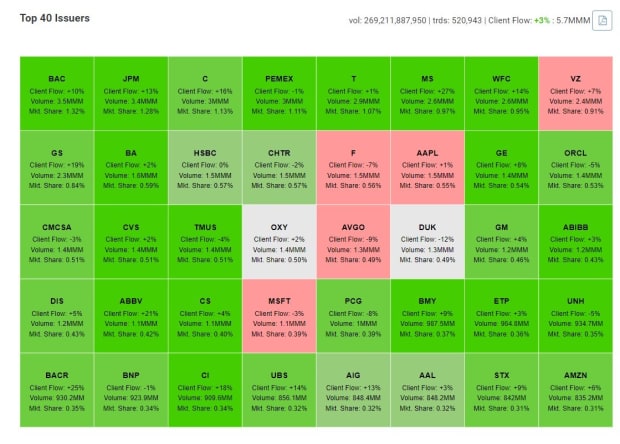
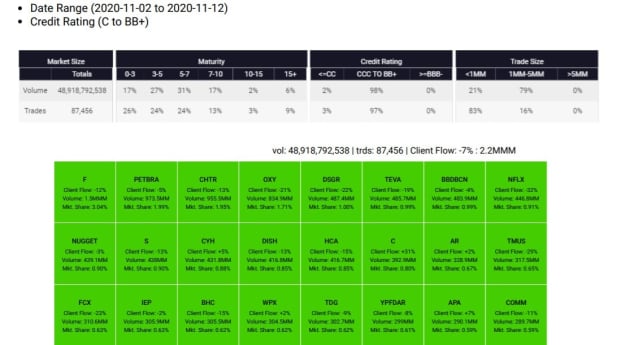

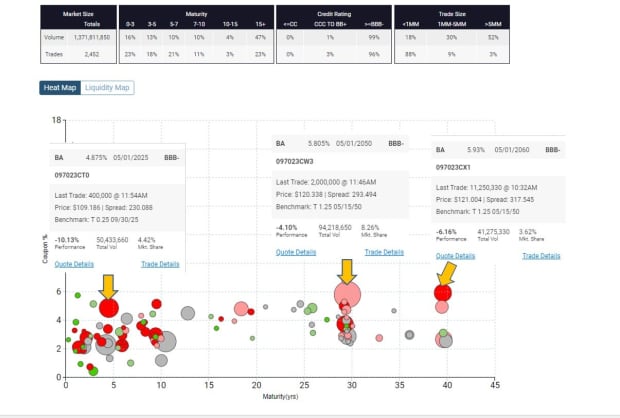
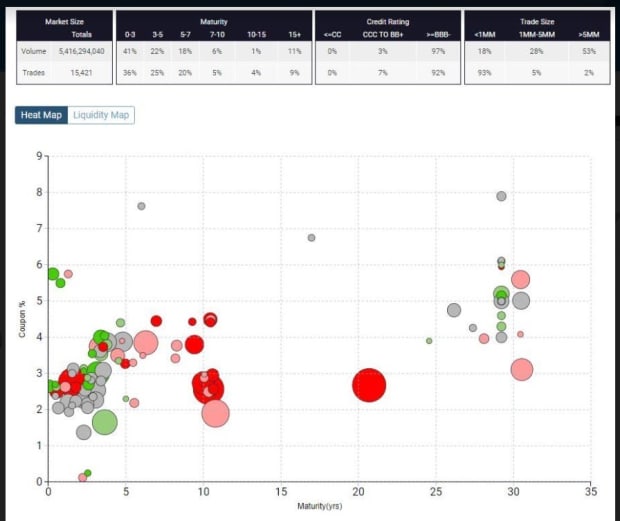
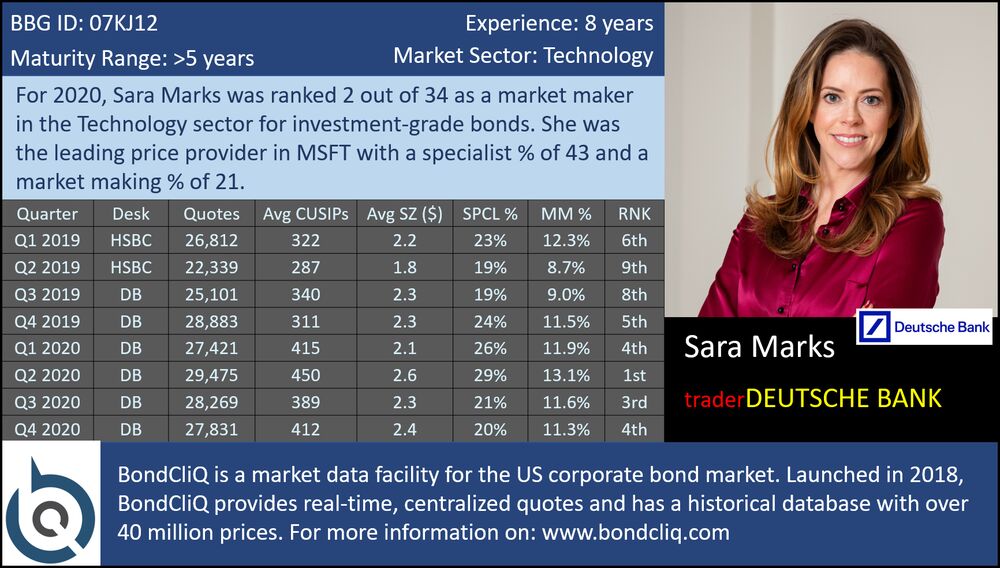






 The need for better tools stems from the conflicts of interest that exist under current models, says Chris White, CEO of Bondcliq, which pulls bid, offer and size data together and feeds it to the buy side, with dealers given feedback on the quality of the prices they are making.
 Horror movies are good clean fun because eventually, the credits roll, and you can return to a world where super-natural monsters aren’t behind every door. Horror markets are longer lasting and far more detrimental to your psyche. To be clear, a substantial downturn in market value is not what terrifies market participants because volatility creates opportunity. What causes real panic in any market is when trading conditions deteriorate to the point where trade execution is severely compromised. When this occurs, both buy-side and sell-side institutions face the same situation. It’s a crowded room, and the exits are blocked. Now you’s can’t leave.
 Contraction
A topic that has received very little attention in the corporate bond liquidity discussion is CUSIP concentration. Looking at volume and bid/ask spreads do not tell the whole story on trading conditions because those metrics omit analysis on what is available to trade. Increasing volumes over a smaller universe of CUSIPs would produce signals that give a false sense of liquidity in the market:
Contraction
A topic that has received very little attention in the corporate bond liquidity discussion is CUSIP concentration. Looking at volume and bid/ask spreads do not tell the whole story on trading conditions because those metrics omit analysis on what is available to trade. Increasing volumes over a smaller universe of CUSIPs would produce signals that give a false sense of liquidity in the market:
 It is not hard to imagine how CUSIP concentration has the potential to spiral. With a smaller universe of bonds trading in the market, there are less TRACE prints for CUSIPs that are not actively traded. The longer non-active bonds go without transaction data, the harder they are to trade, which exacerbates the concentration issue even further. To think, less than a year ago, there were loud voices in the market asking for a reduction in the dissemination of transaction data. Wow.
Reversal of Customer Flows
An interesting phenomenon that we covered in a previous research note was how customer flows have remained positive in the face of COVID-19 pressure. From 2/24 to 3/13, buy-side institutions were net buyers of corporate debt with a net purchase volume of $19.1B during the period. Positive customer flows were observed in every sector. In contrast, the week of 3/16 to 3/20 had negative customer flows with net sales volume of $3.6B. Positive customer flows were only observed in 3 out of 10 sectors. This reversal has gained momentum going into this week, with $9.4B net sales imbalance from the 23rd to the 24th with every single sector showing negative customer flows.
It is not hard to imagine how CUSIP concentration has the potential to spiral. With a smaller universe of bonds trading in the market, there are less TRACE prints for CUSIPs that are not actively traded. The longer non-active bonds go without transaction data, the harder they are to trade, which exacerbates the concentration issue even further. To think, less than a year ago, there were loud voices in the market asking for a reduction in the dissemination of transaction data. Wow.
Reversal of Customer Flows
An interesting phenomenon that we covered in a previous research note was how customer flows have remained positive in the face of COVID-19 pressure. From 2/24 to 3/13, buy-side institutions were net buyers of corporate debt with a net purchase volume of $19.1B during the period. Positive customer flows were observed in every sector. In contrast, the week of 3/16 to 3/20 had negative customer flows with net sales volume of $3.6B. Positive customer flows were only observed in 3 out of 10 sectors. This reversal has gained momentum going into this week, with $9.4B net sales imbalance from the 23rd to the 24th with every single sector showing negative customer flows.
 This combination of lower volumes, less CUSIPs trading and negative customer flows raise an important question: What is happening with all the new ideas that were promoted as solutions to US corporate bond trading problems?
 Several sources in the market have stated that “all the algos have been turned off,” which is an ominous sign for their reliability during times of persistent volatility. This is not the case in other markets that have leveraged algorithmic trading techniques for years (ex: FX, Equities, TSYs, Futures, Options). The common denominator for consistency of algo trading is the quality of data used to maintain the pricing engine. In the corporate bond market, there is a dearth of high-quality pricing data to begin with. During times of high volatility, accurate information in the corporate bond market becomes scarce. Without improving the pricing inputs for corporate bond trading algos, they will forever be subject to service disruptions.
Platforms Providing Liquidity
Most of the dialogue on corporate bond market structure is provided by people that have a solution to sell, current company included. Therefore, it is no surprise that a narrative that electronic trading platforms provide liquidity has been gaining momentum over the years:
Several sources in the market have stated that “all the algos have been turned off,” which is an ominous sign for their reliability during times of persistent volatility. This is not the case in other markets that have leveraged algorithmic trading techniques for years (ex: FX, Equities, TSYs, Futures, Options). The common denominator for consistency of algo trading is the quality of data used to maintain the pricing engine. In the corporate bond market, there is a dearth of high-quality pricing data to begin with. During times of high volatility, accurate information in the corporate bond market becomes scarce. Without improving the pricing inputs for corporate bond trading algos, they will forever be subject to service disruptions.
Platforms Providing Liquidity
Most of the dialogue on corporate bond market structure is provided by people that have a solution to sell, current company included. Therefore, it is no surprise that a narrative that electronic trading platforms provide liquidity has been gaining momentum over the years:
 The absence of high-quality pricing data in the corporate bond market has created an environment where numerous model-based pricing solutions have taken hold. These solutions determine the true value of a bond by, “leveraging the relationships between bonds; based on factors such as liquidity, maturity, time since issuance, amongst other things.” While this process for determining the value of a bond may sound more like art than science, model-based pricing is the only game in town for calculating best-execution, transaction costs and most importantly, portfolio valuations. Just before the COVID-19 crisis, a new model-based pricing product had claimed a breakthrough in accuracy:
 At BondCliQ, we are singularly focused on improving transparency for market makers to produce the missing architecture for corporate bond market modernization: high-quality, centralized pricing data. Our approach is based on 50 years of financial market structure history. This past Friday, we had the privilege to present the details of our initiative at The Future of Market Technology Symposium hosted by Autonomous Research (Click here for video presentation of ‘Transparency and Market Liquidity’). As adoption of BondCliQ grows, imagine the positive impact the resulting data will have on dealer performance, electronic trading, algorithmic strategies and model-based pricing solutions. Now imagine what those improvements would mean for corporate bond market liquidity.
-Chris White
At BondCliQ, we are singularly focused on improving transparency for market makers to produce the missing architecture for corporate bond market modernization: high-quality, centralized pricing data. Our approach is based on 50 years of financial market structure history. This past Friday, we had the privilege to present the details of our initiative at The Future of Market Technology Symposium hosted by Autonomous Research (Click here for video presentation of ‘Transparency and Market Liquidity’). As adoption of BondCliQ grows, imagine the positive impact the resulting data will have on dealer performance, electronic trading, algorithmic strategies and model-based pricing solutions. Now imagine what those improvements would mean for corporate bond market liquidity.
-Chris White  From the looks of it, no portfolio was safe as the top 20 names by volume in each sector saw their underlying bonds lose value. The only exception for the week was Mallinckrodt, a CCC- rated, a generic drug manufacturer that agreed to settle an opioid lawsuit for $1.6 billion. Distressed bond trading is weird…
 This image illustrates why it is critical that corporate bond market data be included in the broader discussion on financial market performance. While the stock market can be relied on for accurately reflecting the present feelings of investors, the bond market articulates the longer term financial market outlook. Undoubtedly, buy-side institutions treated last week as an opportunity to pick up yield and were not dismayed by the Coronavirus.
There is even more evidence of market support when we look at the market on a sector and maturity basis. For the week, long end (>=10yr), investment-grade Financials also had positive client flow, especially for the top four issuers by volume:
This image illustrates why it is critical that corporate bond market data be included in the broader discussion on financial market performance. While the stock market can be relied on for accurately reflecting the present feelings of investors, the bond market articulates the longer term financial market outlook. Undoubtedly, buy-side institutions treated last week as an opportunity to pick up yield and were not dismayed by the Coronavirus.
There is even more evidence of market support when we look at the market on a sector and maturity basis. For the week, long end (>=10yr), investment-grade Financials also had positive client flow, especially for the top four issuers by volume:
 Clients were net buyers of 13 out of the 16 most active issuers when looking at this section of the market. Maybe they were pricing in what is already being predicted this week, a central bank rescue plan to get markets back on track. Undoubtedly, this is a windfall for the banks, just like every other QE initiative post-2008.
 Every January begins with resolutions of new routines designed to create a better version of yourself. Read more books, learn something new each day, meditate each morning, etc.
This ritual is a rare occasion when your future self is in full control and sets the agenda that your present-self must follow. Typically, it is the other way around. We favor our present self to the detriment of our future self. A late-night pint of ice cream may feel good at the time, but you’re paying for it later.
Week’s after New Year’s resolutions have been established, the bad habits gradually return. You may get through a dry January, but come mid-February, the present self is back in control, and immediate satisfaction is all that matters (it’s Wine O’Clock baby!).
As the US corporate bond market enters 2020, there is one resolution that buy-side institutions must not break: Improving their institutional corporate bond data diet.
Because the data you consume now will have an impact on your future performance.
Every January begins with resolutions of new routines designed to create a better version of yourself. Read more books, learn something new each day, meditate each morning, etc.
This ritual is a rare occasion when your future self is in full control and sets the agenda that your present-self must follow. Typically, it is the other way around. We favor our present self to the detriment of our future self. A late-night pint of ice cream may feel good at the time, but you’re paying for it later.
Week’s after New Year’s resolutions have been established, the bad habits gradually return. You may get through a dry January, but come mid-February, the present self is back in control, and immediate satisfaction is all that matters (it’s Wine O’Clock baby!).
As the US corporate bond market enters 2020, there is one resolution that buy-side institutions must not break: Improving their institutional corporate bond data diet.
Because the data you consume now will have an impact on your future performance.
 Celebrities are often the face of campaigns about weight loss and fitness, but their approach is costly to replicate. Personal chefs, personal trainers, and a steady supply of organic food are at their disposal. With such an edge, it is no wonder that they can rapidly and dramatically lose weight and get fit.
The buy-side landscape for institutional pre-trade corporate bond data is very similar. Over the past few years, some of the largest asset managers have been focusing on enhancing the value of pre-trade institutional, corporate bond data. These organizations have committed sizable technology resources to produce their own, proprietary pre-trade data. Their pricing information is superior in quality to what other asset managers use (IMGR, model-based prices, etc) because they capture as much information as possible, and then test and analyze the data to remove inaccurate markets and poor performing dealers. Once complete, these advanced asset-managers have a steady diet of higher-quality pre-trade data to improve their trading process, where it matters most, block execution:
Celebrities are often the face of campaigns about weight loss and fitness, but their approach is costly to replicate. Personal chefs, personal trainers, and a steady supply of organic food are at their disposal. With such an edge, it is no wonder that they can rapidly and dramatically lose weight and get fit.
The buy-side landscape for institutional pre-trade corporate bond data is very similar. Over the past few years, some of the largest asset managers have been focusing on enhancing the value of pre-trade institutional, corporate bond data. These organizations have committed sizable technology resources to produce their own, proprietary pre-trade data. Their pricing information is superior in quality to what other asset managers use (IMGR, model-based prices, etc) because they capture as much information as possible, and then test and analyze the data to remove inaccurate markets and poor performing dealers. Once complete, these advanced asset-managers have a steady diet of higher-quality pre-trade data to improve their trading process, where it matters most, block execution:
 Access to pre-trade institutional data is not the issue for the buy-side community. There is a great deal of information available, but a material amount of institutional pricing is like junk food. It may look good and taste good, but there is no nutritional value for actual trading:
 Knowing where the data comes from is very important question for buy-side institutions. Beware of products in the market that may look like a quick fix solution for high-quality institutional pricing. Several vendors capture and present dealer prices without the knowledge of the dealers. In the long run, this presents a fuzzy, but serious dilemma for any buy-side client that builds their systems and tools around ill-begotten data sources. Like Napster, at some point, the music will stop because those vendors do not have the right to productize information that was not intended for their consumption. When that happens, the buy-side institutions that relied on these sources will have to scramble to find a replacement provider and may have to forfeit their invaluable catalog of historical data.
 For buy-side institutions to get the results of a leaner and more effective block trading process, it starts with ingesting the proper pre-trade data. BondCliQ has developed an institutional pricing source that produces high-quality data without buy-side institutions bearing the burden of high costs and substantial IT resources. Our platform is a “Farm to Table” solution that delivers pricing information directly from participating corporate bond dealers to your firm. We improve the health of your front office applications, risk systems, and analytics by creating an environment where institutional data will get better over time. What more do you need to keep this New Year’s resolution intact?
-Chris White (CEO, BondCliQ)
For buy-side institutions to get the results of a leaner and more effective block trading process, it starts with ingesting the proper pre-trade data. BondCliQ has developed an institutional pricing source that produces high-quality data without buy-side institutions bearing the burden of high costs and substantial IT resources. Our platform is a “Farm to Table” solution that delivers pricing information directly from participating corporate bond dealers to your firm. We improve the health of your front office applications, risk systems, and analytics by creating an environment where institutional data will get better over time. What more do you need to keep this New Year’s resolution intact?
-Chris White (CEO, BondCliQ)  Judging the quality of corporate bond market data is a subjective process, especially when it comes to assessing the reliability of pricing information. Multiple factors like venue, time when the market was posted, size displayed, and the identity of the provider go into the equation that determines whether a price is dependable for trading. However, the feature that seems to trump all other inputs is whether the price is “executable” which means it can be traded electronically “on screen.” In other markets, a live price is considered an “order,” which means there is no last look afforded to the person who posts the market. Once someone tries to hit or lift the price, the trade is executed. Many corporate bond platforms have tried to convert indicative prices into “order-driven” executable markets, but the same issue ultimately prevents this from happening: backing away.
Backing away is when a price provider does not stand up to their market. This practice is in no way unique to electronic trading and happens all the time for both large and small transactions. If it wasn’t for backing away, we wouldn’t need lawyers when closing on a house and pinky swears would become a relic of the past. For capital markets, when a price is posted electronically and appears to you on screen, there is a natural expectation that the market is real. However, creating an environment where dealers will stand and deliver liquidity against their posted prices is not easy.
Judging the quality of corporate bond market data is a subjective process, especially when it comes to assessing the reliability of pricing information. Multiple factors like venue, time when the market was posted, size displayed, and the identity of the provider go into the equation that determines whether a price is dependable for trading. However, the feature that seems to trump all other inputs is whether the price is “executable” which means it can be traded electronically “on screen.” In other markets, a live price is considered an “order,” which means there is no last look afforded to the person who posts the market. Once someone tries to hit or lift the price, the trade is executed. Many corporate bond platforms have tried to convert indicative prices into “order-driven” executable markets, but the same issue ultimately prevents this from happening: backing away.
Backing away is when a price provider does not stand up to their market. This practice is in no way unique to electronic trading and happens all the time for both large and small transactions. If it wasn’t for backing away, we wouldn’t need lawyers when closing on a house and pinky swears would become a relic of the past. For capital markets, when a price is posted electronically and appears to you on screen, there is a natural expectation that the market is real. However, creating an environment where dealers will stand and deliver liquidity against their posted prices is not easy.
 To many, breaking a deal, any deal requires serious consequences to deter others from repeating the same offense. In the early days of financial market systems, an individual’s honor and reputation were the only collateral because there was little to no technology to enforce market integrity. This explains the old London Stock Exchange Motto: Dictum Meum Pactum – My Word is My Bond.
There is a growing assumption in the corporate bond market that technology and e-trading alone will ensure price integrity, but this has proven to be incorrect across multiple markets
To many, breaking a deal, any deal requires serious consequences to deter others from repeating the same offense. In the early days of financial market systems, an individual’s honor and reputation were the only collateral because there was little to no technology to enforce market integrity. This explains the old London Stock Exchange Motto: Dictum Meum Pactum – My Word is My Bond.
There is a growing assumption in the corporate bond market that technology and e-trading alone will ensure price integrity, but this has proven to be incorrect across multiple markets
 Nostalgia is a funny thing because it tends to distort the truth by presenting past events or eras as if they were much better or worse than reality. The stories of how it used to be are most often told to those who lack firsthand experience, so facts rarely get in the way of the storyteller’s perspective. Recount a story enough times with enough distance between the past and the present, and the lines between someone’s view and real history start to blur. This isn’t a problem when people discuss something inconsequential like their old high school athletic career. However, when a nostalgic view of the past is treated as a guide for the future, mistakes can and will be made.
 To translate a bit here, the concept of “working orders” in a market assumes that there is at least one well-functioning electronic order book to rest an order. In addition, putting some of those orders “in the machine” assumes that there are MULTIPLE well-functioning orders books, which would allow the investor to realize the benefits of smart order routing. Now it is not a huge leap of faith to believe that an electronic order book could be built and launched for the corporate bond market. Multiple ECNs like Tradeweb Direct, TMC, MTS Bonds, UBS Bond Port and Knight Bondpoint have successfully established platforms that closely resemble order books with reliable markets for small sized (<$250k) trades. What this neat and tidy vision of corporate bond market evolution fails to acknowledge is that establishing price integrity on a broader scale is very difficult. We know this because back in the day, the US equity market struggled with the exact same issue of backing away. So while it sounds great to say that billions could be saved if we followed the path of equities, that path is long, difficult and not achieved by simply launching a platform with “live markets.”
 I was recently reading a few old articles about market structure which is just a slightly more exciting hobby than stamp collecting. Every now and then I find content that can be best described as a time capsule because the market structure conditions and practices being discussed are all but forgotten. A great thing about historical content is that we know how the story ends so we view the information with full knowledge of the eventual outcome. The title of this excellent Los Angeles Times article from 1994 is very wordy and leaves very little to the imagination:
The Price of Backing Away: NASDAQ Market Makers Often Don’t Honor the Prices They Display. Complaints Abound, But NASD Says Most Are Frivolous. This sounds oddly familiar to the current state of the US corporate bond market where execution quality can be suspect.
If you’ve assumed that the good old days of electronic trading in equities meant reliable prices, then there are a few startling statements in the 1994 Los Angeles Times article:
I was recently reading a few old articles about market structure which is just a slightly more exciting hobby than stamp collecting. Every now and then I find content that can be best described as a time capsule because the market structure conditions and practices being discussed are all but forgotten. A great thing about historical content is that we know how the story ends so we view the information with full knowledge of the eventual outcome. The title of this excellent Los Angeles Times article from 1994 is very wordy and leaves very little to the imagination:
The Price of Backing Away: NASDAQ Market Makers Often Don’t Honor the Prices They Display. Complaints Abound, But NASD Says Most Are Frivolous. This sounds oddly familiar to the current state of the US corporate bond market where execution quality can be suspect.
If you’ve assumed that the good old days of electronic trading in equities meant reliable prices, then there are a few startling statements in the 1994 Los Angeles Times article:
 computers and technology play a dominant role in almost every aspect of life, creating a world that is unrecognizable from what we know today. Things are neat, clean, and simple because robots and push-button solutions take care of everything from food to travel.
The other type of sci-fi presents a world that is complicated by innovation. While new technology provides benefits, it also creates new problems and dilemmas that require human
computers and technology play a dominant role in almost every aspect of life, creating a world that is unrecognizable from what we know today. Things are neat, clean, and simple because robots and push-button solutions take care of everything from food to travel.
The other type of sci-fi presents a world that is complicated by innovation. While new technology provides benefits, it also creates new problems and dilemmas that require human  intervention to solve. Given what we’ve seen in the last 35 years, the more complicated version of the future is far more plausible.
Late last week, a Bloomberg article discussed the potential for technology to “replace traders with algorithms and replace salespeople with APIs.” The goal of this effort is to move big corporate bond trades from the phone and chat to a screen, just like trading in stocks, currencies, and futures. This is not the first article of its kind, but typical of a widely held view that “going electronic” is the panacea for bond liquidity. Those that evangelize this idea often do so while omitting critical details about the real impact of electronic trading on financial market structure. Instead, we are presented with a neat, clean, corporate bond market of the future that requires little to no human support. The real story on electronic trading in financial markets is far more complicated.
intervention to solve. Given what we’ve seen in the last 35 years, the more complicated version of the future is far more plausible.
Late last week, a Bloomberg article discussed the potential for technology to “replace traders with algorithms and replace salespeople with APIs.” The goal of this effort is to move big corporate bond trades from the phone and chat to a screen, just like trading in stocks, currencies, and futures. This is not the first article of its kind, but typical of a widely held view that “going electronic” is the panacea for bond liquidity. Those that evangelize this idea often do so while omitting critical details about the real impact of electronic trading on financial market structure. Instead, we are presented with a neat, clean, corporate bond market of the future that requires little to no human support. The real story on electronic trading in financial markets is far more complicated.
 Removing a salesperson from the trading process has an obvious consequence: minimizing transaction sizes. Why? Because when you attempt to trade large size electronically, the market moves away from you. Without the ability to bi-laterally negotiate a block trade with a human being, buy-side institutions must break down their block orders into micro-lots to hopefully avoid detection on electronic platforms.
 According to the Bloomberg article, “Thirty percent of all bond trades are electronic, an all-time high.” FINRA does not track or publish pure electronic trading volumes for corporate bonds, so this may be more of an opinion than a factual statement. Missing from this and other declarations of corporate bond electronic growth are the details. What, exactly is trading electronically? We do not see the details because the true e-trading narrative may not be as exciting as we’ve been led to believe. What if a large percentage of corporate bond e-trading volumes were comprised of recently issued bonds and short duration (<7 years) investment-grade paper? These areas of the market have historically not had liquidity issues, so the net impact of electronic trading could be improving execution efficiency in bonds that are easy to trade while freeing up human traders to focus on more difficult, higher value transactions
A quick examination of the highly electronic US options market illustrates that very few contracts make up most market volumes. In fact, the NYSE reported that options on SPY accounted for nearly 20% of options volume for 2018.
According to the Bloomberg article, “Thirty percent of all bond trades are electronic, an all-time high.” FINRA does not track or publish pure electronic trading volumes for corporate bonds, so this may be more of an opinion than a factual statement. Missing from this and other declarations of corporate bond electronic growth are the details. What, exactly is trading electronically? We do not see the details because the true e-trading narrative may not be as exciting as we’ve been led to believe. What if a large percentage of corporate bond e-trading volumes were comprised of recently issued bonds and short duration (<7 years) investment-grade paper? These areas of the market have historically not had liquidity issues, so the net impact of electronic trading could be improving execution efficiency in bonds that are easy to trade while freeing up human traders to focus on more difficult, higher value transactions
A quick examination of the highly electronic US options market illustrates that very few contracts make up most market volumes. In fact, the NYSE reported that options on SPY accounted for nearly 20% of options volume for 2018.
 The efficiencies achieved through electronic trading have major benefits to all market participants. However, evidence shows that these benefits can only be applied to areas of a financial market that have certain attributes (large float, good credit quality, known name). Algorithms and APIs can’t solve for execution for bonds that don’t have the same attributes, but humans can.

 Every day the institutional bond market participants must assign a value to individual positions with notional sizes in the millions. This process is a requirement for actively managed portfolios, passively managed index products (ETFs) and inventory held by dealers. Accuracy of portfolio
valuations and risk analytics depends on complete information about prices and transactions. Healthy Markets Association did an excellent job of articulating this point in their comment letter and includes supporting comments from FINRA for good measure:
“Loss of Price References for Market Participants.
Most market participants would lose an incredibly valuable reference point–not just for the security traded, but for similarly situated securities. This could impact evaluative pricing tools, such as those offered by third parties, and relied upon by many market participants – not just in the pricing those specific bonds but other bonds where those prices are used in evaluating fair values. Put simply, all investors other than the dealer involved in the trade would not be aware of the important reference point. This could lead to executions for retail and other institutional investors at materially worse prices. Further, this loss of a reference price may materially impact a number of other financial products, such as bond-based ETFs.
As the FINRA Proposal notes:
The impact of delayed reporting may well have an amplified effect on securities deriving their value from corporate bonds. The impact could lead to less efficient pricing of index-based products, such as ETFs, and derivatives, such as total return and credit default swaps. If the pilot makes it more difficult to mark-to-market the relevant securities, market participants, who do not trade blocks benefitting from delayed reporting dissemination, may be more likely to use stale prices for operational and accounting purposes.
We agree with this significant concern. The data reflects that as much as 50.5% of those block trades occur in bonds that are included in at least one of the seven largest fixed income ETFs. This is a significant concern for investors and market makers in those ETFs.”
Every day the institutional bond market participants must assign a value to individual positions with notional sizes in the millions. This process is a requirement for actively managed portfolios, passively managed index products (ETFs) and inventory held by dealers. Accuracy of portfolio
valuations and risk analytics depends on complete information about prices and transactions. Healthy Markets Association did an excellent job of articulating this point in their comment letter and includes supporting comments from FINRA for good measure:
“Loss of Price References for Market Participants.
Most market participants would lose an incredibly valuable reference point–not just for the security traded, but for similarly situated securities. This could impact evaluative pricing tools, such as those offered by third parties, and relied upon by many market participants – not just in the pricing those specific bonds but other bonds where those prices are used in evaluating fair values. Put simply, all investors other than the dealer involved in the trade would not be aware of the important reference point. This could lead to executions for retail and other institutional investors at materially worse prices. Further, this loss of a reference price may materially impact a number of other financial products, such as bond-based ETFs.
As the FINRA Proposal notes:
The impact of delayed reporting may well have an amplified effect on securities deriving their value from corporate bonds. The impact could lead to less efficient pricing of index-based products, such as ETFs, and derivatives, such as total return and credit default swaps. If the pilot makes it more difficult to mark-to-market the relevant securities, market participants, who do not trade blocks benefitting from delayed reporting dissemination, may be more likely to use stale prices for operational and accounting purposes.
We agree with this significant concern. The data reflects that as much as 50.5% of those block trades occur in bonds that are included in at least one of the seven largest fixed income ETFs. This is a significant concern for investors and market makers in those ETFs.”
 Pushing a pilot program for testing a theory on market structure is no small feat. It requires the formation of a problem. The suggestion of an idea to solve said problem. Then, most importantly, evidence that supports the theory behind the suggested solution. If you’ve been paying attention to the FIMSAC discussions regarding the TRACEs delay, a key argument against the pilot has been the lack of evidence that removing transaction data would help trading conditions.
Citadel smashes this point home like an overhead lob:
“…to the extent there has been any deterioration in block trade liquidity, there is no evidence to suggest that it is due to the current post-trade transparency framework. In contrast, academic research has found that post-trade transparency has improved corporate bond liquidity and has reduced transaction costs. Post-trade transparency has benefited not only retail investors, but also institutional investors transacting in larger size. In particular, academic research has found that posttrade transparency has caused “trading costs to decline significantly for the entire bond market” and has even improved liquidity conditions for block trades, directly contradicting the claims made by those supporting the Proposed Pilot. Specifically, an analysis of the institutional 144A corporate bond market found that the introduction of posttrade transparency in 2014 significantly reduced transaction costs for block trades, with the largest reductions observed for blocks that exceed $25 million in size.
Pushing a pilot program for testing a theory on market structure is no small feat. It requires the formation of a problem. The suggestion of an idea to solve said problem. Then, most importantly, evidence that supports the theory behind the suggested solution. If you’ve been paying attention to the FIMSAC discussions regarding the TRACEs delay, a key argument against the pilot has been the lack of evidence that removing transaction data would help trading conditions.
Citadel smashes this point home like an overhead lob:
“…to the extent there has been any deterioration in block trade liquidity, there is no evidence to suggest that it is due to the current post-trade transparency framework. In contrast, academic research has found that post-trade transparency has improved corporate bond liquidity and has reduced transaction costs. Post-trade transparency has benefited not only retail investors, but also institutional investors transacting in larger size. In particular, academic research has found that posttrade transparency has caused “trading costs to decline significantly for the entire bond market” and has even improved liquidity conditions for block trades, directly contradicting the claims made by those supporting the Proposed Pilot. Specifically, an analysis of the institutional 144A corporate bond market found that the introduction of posttrade transparency in 2014 significantly reduced transaction costs for block trades, with the largest reductions observed for blocks that exceed $25 million in size.  In addition, there was no evidence that post-trade transparency reduced block trading volume or otherwise impeded the ability of market participants to execute blocks, or reduced dealers’ willingness to hold inventory. In fact, overall trading volume of large blocks increased following the introduction of post-trade transparency. FIMSAC did not appear to consider the academic research above as part of its deliberations. Moreover, FIMSAC did not explain why it narrowly focused on suggesting changes to the post-trade transparency framework, as opposed to considering other aspects of market structure that can impact liquidity conditions, such as regulatory capital requirements, the ongoing transition to electronic trading, the observed increase in agency/riskless principal trading, and liquidity dynamics in hedging instruments, such as single-name credit default swaps. Ultimately, neither FIMSAC nor FINRA were able to identify any academic research supporting the suggestion that reducing post-trade transparency can be expected to improve liquidity conditions for block trades. As a result, the asserted benefits of the Proposed Pilot appear to be unsubstantiated and illusory.”
 When designing a trading platform, a virtual market place or even a board game, the rules and protocols cannot be susceptible to manipulation. Any product development person will tell you that a critical part of their process is thinking about behaviors that could “game” the system and coming up with techniques to eliminate those activities. Failure to account for opportunism will ultimately cultivate opportunism, especially in situations where the stakes are high. There is a long history in financial markets of ideas that were intended to enhance market quality, but ended up deteriorating market integrity (cough…SOES…cough…Bandits).
A two-tiered information disemmination structure creates countless scenarios for manipulation, but MIT Management provided a hypothetical, but plausible scenario in their letter.
“Delayed dissemination of trades may also lead to legal and systemic risks in times of stress and uncertainty. Suppose, hypothetically, an issuer faces imminent default, but only market participants close to the firm are informed of this likely event. The transaction prices between those sophisticated investors on the firm’s bonds will reflect the imminent default risk. But if TRACE delays the dissemination of price information, smaller and less sophisticated investors may end up paying for the bonds at higher prices, which they would not pay if TRACE had reported the transaction prices in real time. In this case, those small and less sophisticated investors are materially harmed by the delayed transaction reporting and may rightly resort to legal actions against FINRA. Worse still, if the defaulter in this hypothetical scenario is a systemically important financial institution, suppressing transaction prices of its bonds could even increase systemic risk.”
When designing a trading platform, a virtual market place or even a board game, the rules and protocols cannot be susceptible to manipulation. Any product development person will tell you that a critical part of their process is thinking about behaviors that could “game” the system and coming up with techniques to eliminate those activities. Failure to account for opportunism will ultimately cultivate opportunism, especially in situations where the stakes are high. There is a long history in financial markets of ideas that were intended to enhance market quality, but ended up deteriorating market integrity (cough…SOES…cough…Bandits).
A two-tiered information disemmination structure creates countless scenarios for manipulation, but MIT Management provided a hypothetical, but plausible scenario in their letter.
“Delayed dissemination of trades may also lead to legal and systemic risks in times of stress and uncertainty. Suppose, hypothetically, an issuer faces imminent default, but only market participants close to the firm are informed of this likely event. The transaction prices between those sophisticated investors on the firm’s bonds will reflect the imminent default risk. But if TRACE delays the dissemination of price information, smaller and less sophisticated investors may end up paying for the bonds at higher prices, which they would not pay if TRACE had reported the transaction prices in real time. In this case, those small and less sophisticated investors are materially harmed by the delayed transaction reporting and may rightly resort to legal actions against FINRA. Worse still, if the defaulter in this hypothetical scenario is a systemically important financial institution, suppressing transaction prices of its bonds could even increase systemic risk.”
 While the future state of the US corporate bond market is a topic of constant debate, there is universal agreement that the market has changed. Relative to 20 years ago, the most visible difference in structure is the sheer size of the outstanding market. Discussing the rapid growth of the corporate bond market is not new, but the details of this expansion are profoundly and permanently altering the environment. An in-depth examination of how the US corporate bond market has grown is essential for predicting which new ideas will help participants adapt.

 As a result of central banks continued quantitative easing policies, it has never been easier for public companies to issue bonds with extremely low yields. Of course, just like the sub-prime crisis, the least qualified borrowers have been taking full advantage of this situation and yield-starved investors have no choice. Last year’s WeWork deal provides the perfect illustration of this conundrum:
“This week high-yield bond investors faced a puzzle: how to value a bond sold by an unprofitable company that does not own hard assets or offer a clear outlook for its free cash flow? The company in question was WeWork, the office-sharing company that last year attracted a $4.4bn equity investment from Japan’s Softbank. WeWork, which hired JPMorgan to lead the sale but had more than a dozen other banks working as well, attracted enough demand to increase the sale to $702m from $500m.”
The current “ocean of credit” has created a corporate bond market that has never been more dangerous. While the true risks have yet to fully manifest into losses, investors are not being compensated properly for lending to hazardous companies. This is the equivalent to picking up quarters in front of a steam roller. It only takes one misstep (a default)to flatten your entire portfolio (buy-side) or your balance sheet (sell-side).
As a result of central banks continued quantitative easing policies, it has never been easier for public companies to issue bonds with extremely low yields. Of course, just like the sub-prime crisis, the least qualified borrowers have been taking full advantage of this situation and yield-starved investors have no choice. Last year’s WeWork deal provides the perfect illustration of this conundrum:
“This week high-yield bond investors faced a puzzle: how to value a bond sold by an unprofitable company that does not own hard assets or offer a clear outlook for its free cash flow? The company in question was WeWork, the office-sharing company that last year attracted a $4.4bn equity investment from Japan’s Softbank. WeWork, which hired JPMorgan to lead the sale but had more than a dozen other banks working as well, attracted enough demand to increase the sale to $702m from $500m.”
The current “ocean of credit” has created a corporate bond market that has never been more dangerous. While the true risks have yet to fully manifest into losses, investors are not being compensated properly for lending to hazardous companies. This is the equivalent to picking up quarters in front of a steam roller. It only takes one misstep (a default)to flatten your entire portfolio (buy-side) or your balance sheet (sell-side).
 Any new idea in the US corporate bond market must address the growing population of BBB bonds that now dominate the landscape. By definition, these bonds are on the border of the investment grade universe. A bad quarter (or two) and a BBB issuer can find themselves reclassified as high-yield. Given these mechanics, many BBB bonds trade very differently than higher-rated issues. Transactions are less frequent, electronic trading is more difficult and market data (pricing and transaction information) is at a premium.
 In any given market, there are fears that shape and mold the behavior of the participants. Except for red pens on the trading floor, most fears are unwarranted and dissipate over time due to evolving perspectives. The transformation phase can take years or even decades, but in the end there is often a crescendo of debate before a given fear is permanently cast out. For the US corporate bond market, the recent FINRA request for comment regarding a pilot program to delay block trade reporting may be a sign that this market is reaching an apex in the argument about transparency.


 To avoid the negative effects of transparency, market participants adapt by routinely omitting information and distorting the truth. Before rushing to judgment on these deceptive practices it must be acknowledged that this behavior is quite normal and observed in almost every market. For example, if you are selling your house, do you tell the first potential buyer that they are the first and only interested party? No! You tell them that they are one of many people interested in purchasing your home. Doing so masks the true level of demand, which helps to preserve your asking price.
This is exactly the intention of the proposed 48-hour delay for block trades. Mask the true level of supply or demand in the market to prevent pricing from destabilizing when there are large transactions. Unfortunately, removing transaction information from a marketplace will lead to a smaller network for trading because less information will discourage broad participation, undoubtedly hurting liquidity in the long run. Using our real-estate example, you would receive fewer inquiries for purchasing your home if there was no available information regarding the transaction prices of similar properties in your location. Furthermore, the initial act of setting the price would be impeded by the lack of transaction data.
Extracting the benefits of transparency while eliminating its detrimental effects requires techniques that are normally reserved for electronic trading platforms. To get the best out of transparency, we need protocols. Applied properly, the right transparency protocols will increase access to information while protecting the proprietary data that can destabilize a market. Regrettably, mandated transparency initiatives rarely include anything but basic protocols that are universally applied to all market participants. As a result, transparency has historically brought unintended negative consequences that reinforce the fear of information.
To avoid the negative effects of transparency, market participants adapt by routinely omitting information and distorting the truth. Before rushing to judgment on these deceptive practices it must be acknowledged that this behavior is quite normal and observed in almost every market. For example, if you are selling your house, do you tell the first potential buyer that they are the first and only interested party? No! You tell them that they are one of many people interested in purchasing your home. Doing so masks the true level of demand, which helps to preserve your asking price.
This is exactly the intention of the proposed 48-hour delay for block trades. Mask the true level of supply or demand in the market to prevent pricing from destabilizing when there are large transactions. Unfortunately, removing transaction information from a marketplace will lead to a smaller network for trading because less information will discourage broad participation, undoubtedly hurting liquidity in the long run. Using our real-estate example, you would receive fewer inquiries for purchasing your home if there was no available information regarding the transaction prices of similar properties in your location. Furthermore, the initial act of setting the price would be impeded by the lack of transaction data.
Extracting the benefits of transparency while eliminating its detrimental effects requires techniques that are normally reserved for electronic trading platforms. To get the best out of transparency, we need protocols. Applied properly, the right transparency protocols will increase access to information while protecting the proprietary data that can destabilize a market. Regrettably, mandated transparency initiatives rarely include anything but basic protocols that are universally applied to all market participants. As a result, transparency has historically brought unintended negative consequences that reinforce the fear of information.


 If you have never been a part of an organization that is managing an electronic trading platform, launching a new system can be best described as throwing a party in high school…that is, if you were a person who was extremely awkward and self-conscious. You’ve sent the invitations, talked it up all over school, made a killer dance mix, but you have no idea if people will show up…now imagine going through that feeling every single day. That’s what it is like when you are trying to establish a new trading platform in the US corporate bond market.
  By far this is THE most popular opinion on why GSessions ultimately didn’t work (both internally and externally). The theory is that clients liked the protocols but were uncomfortable with the fact that Goldman was the center of each trade and had access to their order information. In anticipation of this skepticism, we had protocols in place to protect customer identities and froze all trading of the issue during a session, but there was still a “trust us” factor to GSessions that was not ideal. To further complicate matters, there was a certain Op-Ed in the NY Times that really did not help the cause. Let me tell you my friends, if you’ve never pitched a new dark pool trading system to a client who thinks you and your colleagues routinely call them ‘muppets’ behind their back, you have not lived! There is no doubt about it, aversion to a single-dealer trading solution was a factor in why the GSessions platform failed, but I don’t think it was the biggest obstacle.
  Buy-side institutions are used to being able to transact what they want, when they want, so GSessions would have to consistently demonstrate liquidity and cost benefits that would outweigh the sacrifice. It didn’t. So it is safe to say that scheduled trading was certainly an obstacle to success, but I think this could be characterized as an undesirable feature, and not a fatal flaw.

 bond market, this process involves a slew of articles, opinion pieces, and research meant to identify the coming trends that will change the market. One prediction for 2019 really caught my attention: Corporate Bond Trading Platforms Are Going to Face Consolidation. There are several interesting components to this perspective, the first of which is the underlying thesis that customers aren’t interested in having to connect with multiple platforms. There is a nuance here that needs greater attention. Despite an abundance of FIX API feeds from individual platforms, there is no “out of the box” solution in the US corporate bond market that provides seamless connectivity across all platforms, so customers are rightfully daunted by the prospect of doing it themselves. Perhaps this fear is being misinterpreted as a lack of interest in new platforms, but I doubt it. If there was less friction to combining multiple platforms, market participants would absolutely welcome more electronic liquidity pools. This is especially the case for the corporate bond market makers who are most negatively impacted by the lack of competition in the electronic trading space.
The next component of the platform consolidation prediction is that fewer solutions would provide better liquidity and data in the
bond market, this process involves a slew of articles, opinion pieces, and research meant to identify the coming trends that will change the market. One prediction for 2019 really caught my attention: Corporate Bond Trading Platforms Are Going to Face Consolidation. There are several interesting components to this perspective, the first of which is the underlying thesis that customers aren’t interested in having to connect with multiple platforms. There is a nuance here that needs greater attention. Despite an abundance of FIX API feeds from individual platforms, there is no “out of the box” solution in the US corporate bond market that provides seamless connectivity across all platforms, so customers are rightfully daunted by the prospect of doing it themselves. Perhaps this fear is being misinterpreted as a lack of interest in new platforms, but I doubt it. If there was less friction to combining multiple platforms, market participants would absolutely welcome more electronic liquidity pools. This is especially the case for the corporate bond market makers who are most negatively impacted by the lack of competition in the electronic trading space.
The next component of the platform consolidation prediction is that fewer solutions would provide better liquidity and data in the long run. There is history here that needs to be referenced because this exact debate was held in the US equity market about 50 years ago. At that time, the future of the market was in doubt because of a persistent lack of institutional liquidity (sounds familiar no?). The argument was whether a regulated monopoly (NYSE) or free competition would lead to a better secondary trading environment. Free competition won because, in the long run, most people believed that a monopoly solution would create greater systemic risks with higher transaction costs. Ultimately, the free competition supporters have been proven right. Electronic trading costs in the US equity market have never been lower and when there is an outage at any exchange, even the NYSE, the market keeps trading without a hitch. Meanwhile, the recent technology glitch at BrokerTec provides a preview of what could happen if the US corporate bond market adopts a monopoly solution approach.
Collaboration beats Consolidation
long run. There is history here that needs to be referenced because this exact debate was held in the US equity market about 50 years ago. At that time, the future of the market was in doubt because of a persistent lack of institutional liquidity (sounds familiar no?). The argument was whether a regulated monopoly (NYSE) or free competition would lead to a better secondary trading environment. Free competition won because, in the long run, most people believed that a monopoly solution would create greater systemic risks with higher transaction costs. Ultimately, the free competition supporters have been proven right. Electronic trading costs in the US equity market have never been lower and when there is an outage at any exchange, even the NYSE, the market keeps trading without a hitch. Meanwhile, the recent technology glitch at BrokerTec provides a preview of what could happen if the US corporate bond market adopts a monopoly solution approach.
Collaboration beats Consolidation
 The BondCliQ approach to improving the US corporate bond market is to collaborate with other service providers to create transformative solutions. We view our centralized, institutional pricing data and data visualization application, BondTiQ, as being components of a better market. Our products are designed to be interoperable with electronic trading systems, EMS providers, OMS providers, and evaluated pricing services, so end-users and vendors can benefit from greater access to high-quality pricing data. We believe in the vision articulated by desktop operating systems like OpenFin and Finsemble and further echoed by platforms like Algomi that combining best-in-class solutions is the ideal model for the end user. Therefore, my prediction for 2019 is that the desktop experience for US corporate bond market data and analytics will materially advance, while the user experience for electronic trading will remain stagnant due to lack of collaborative solutions.
Competition and collaboration are the yeast in the dough of innovation. Without it, US corporate bond market participants will be very disappointed with what comes out of the oven in the next few years…ok, now I’ve made myself hungry.
-Chris White (CEO – BondCliQ)
The BondCliQ approach to improving the US corporate bond market is to collaborate with other service providers to create transformative solutions. We view our centralized, institutional pricing data and data visualization application, BondTiQ, as being components of a better market. Our products are designed to be interoperable with electronic trading systems, EMS providers, OMS providers, and evaluated pricing services, so end-users and vendors can benefit from greater access to high-quality pricing data. We believe in the vision articulated by desktop operating systems like OpenFin and Finsemble and further echoed by platforms like Algomi that combining best-in-class solutions is the ideal model for the end user. Therefore, my prediction for 2019 is that the desktop experience for US corporate bond market data and analytics will materially advance, while the user experience for electronic trading will remain stagnant due to lack of collaborative solutions.
Competition and collaboration are the yeast in the dough of innovation. Without it, US corporate bond market participants will be very disappointed with what comes out of the oven in the next few years…ok, now I’ve made myself hungry.
-Chris White (CEO – BondCliQ)
